
You may benefit from keloid treatment if you have a raised, growing, or symptomatic scar, particularly in visible areas, or if you have a personal or family history of keloids.
- New Website Same Amazing Team!
- Request a Consultation Here

At Dr Mistry Specialist Plastic Surgeon in Charlestown, patients from Newcastle, Lake Macquarie, and the Hunter region can access comprehensive care for keloid scars. Under the experienced care of Dr Yezdi Mistry, Specialist Plastic and Reconstructive Surgeon (BHB, MBChB, FRACS – Plastic Surgery, Registration No. MED0001861566), each treatment plan is designed with a reconstructive and functional focus. The aim is to manage symptoms such as itching, tenderness, or tightness, reduce the raised nature of the scar, and improve the overall skin texture and comfort in affected areas. Because keloids can recur, Dr Mistry develops personalised and carefully staged treatment plans that take into account a person’s skin characteristics, medical history, and the specific features of the scar.
A keloid is a raised, firm, and sometimes itchy scar that develops when the healing process continues beyond what is required after an injury. This happens due to overproduction of collagen in the skin. While all scars are part of the natural repair process, keloids behave differently in that they grow beyond the boundary of the original wound and rarely regress on their own. Keloids can appear months or even years after an injury, and they may continue to expand slowly over time.
These scars often develop after skin trauma such as surgery, burns, acne, piercings, tattoos, or even minor cuts. Common areas affected include the shoulders, chest, earlobes, and upper back. The reason they occur in certain individuals is not fully understood, though genetic predisposition and darker skin types may play a role. A personal or family history of keloid formation increases the likelihood of developing them again in future wounds. They can cause discomfort, tenderness, or restriction of movement if located near joints, and may occasionally cause irritation when rubbed by clothing or accessories.
The difference between a hypertrophic and keloid scar lies in the boundaries of growth. While hypertrophic scars stay within the wound area and often flatten over time, keloids extend beyond and continue to enlarge. Understanding this difference is important, as it influences treatment decisions and long-term management.
Keloid scar treatment may be considered by anyone who experiences persistent itching, pain, or irritation from a raised scar. Some people find their scars interfere with daily comfort, particularly if located in areas subject to friction or movement. In some cases, keloids can restrict movement when they form over joints or high-tension areas such as the chest or shoulders. Others may seek care because the scar continues to enlarge despite previous treatments or conservative measures.
People who have experienced keloids in the past, or who have a strong family tendency toward raised scars, often seek preventive advice before planned surgery or piercings. Consultation with a qualified plastic surgeon helps determine the most appropriate approach to minimise recurrence. Early intervention can be beneficial, as newer keloids may respond more effectively to certain treatments than long-standing ones. Medical review is especially important if a scar becomes painful, ulcerated, or changes in appearance, as this may require further assessment to rule out other causes.
The primary aim of treatment is to control symptoms and reduce the volume and firmness of the scar tissue. With ongoing management, keloids can become softer and flatter over time. Many patients also notice improvement in itching, tenderness, or sensitivity once treatment begins. This can make wearing clothing or accessories more comfortable and help reduce discomfort during movement.
Functional benefits may include improved range of motion in areas where scars previously restricted movement. Over time, the scar may blend more evenly with the surrounding skin, although results differ for each individual. Treatment can also help maintain skin flexibility and reduce the risk of cracking or irritation, which can sometimes occur in thickened scar tissue.
Managing a keloid is an ongoing process rather than a single procedure, and it may take multiple sessions and a combination of therapies to achieve optimal control. Dr Mistry explains all available options clearly during the consultation so that patients have a realistic understanding of what can be achieved.
Because each person’s skin type, healing pattern, and keloid characteristics are unique, outcomes vary significantly. During your consultation, Dr Mistry may provide the opportunity to view educational examples that demonstrate how scars can respond to different treatments. These are shown in accordance with AHPRA advertising guidelines and are used to illustrate the principles of care rather than to predict a specific result.
Your consultation with Dr Mistry is an essential step in understanding your options. The discussion begins with a detailed review of your medical and treatment history. This includes the origin of your keloid, whether it developed after a piercing, acne, injury, or surgery, and any previous treatments you may have tried such as silicone therapy, steroid injections, or laser treatments. Dr Mistry will explore your goals and any symptoms you wish to manage, such as tenderness or tightness.
A careful physical examination follows. This allows assessment of the scar’s size, thickness, texture, and the surrounding skin. Its position in relation to joint lines or areas of frequent movement is also considered, as this may influence management. In some cases, photographs are taken for your confidential medical record, to document progress over time.
Dr Mistry then explains available treatment pathways. Depending on your needs, he may recommend non-operative approaches such as silicone or steroid therapy, or operative options that include surgical removal combined with adjuvant therapies. Each plan is designed to balance effectiveness with the risk of recurrence. The consultation also provides time to discuss expected results, recovery phases, and any necessary maintenance care.
Preparing for treatment may involve avoiding new piercings or skin trauma, stopping certain medications if advised, and ensuring the area is well protected from sun exposure. Patients are encouraged to bring a list of any medications or allergies to assist with safe planning.
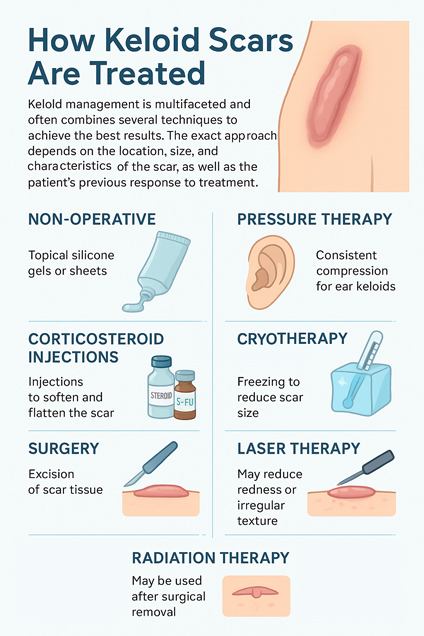
Keloid management is multifaceted and often combines several techniques to achieve the best results. The exact approach depends on the location, size, and characteristics of the scar, as well as the patient’s previous response to treatment.
Non-operative treatments include topical silicone gels or sheets, which are applied to the skin for extended periods to help flatten and hydrate the scar. Pressure therapy can also be beneficial, particularly for ear keloids, by applying consistent compression that limits further tissue growth. Corticosteroid injections are frequently used to soften and flatten the scar tissue and reduce inflammation. In some cases, a combination of medications such as corticosteroids and 5-fluorouracil is injected to target collagen production and enhance results.
Cryotherapy involves freezing the scar tissue to cause gradual reduction in size. This may be combined with other treatments for improved effectiveness. Laser therapy may also be used, particularly to reduce redness or surface irregularity. Patients undergoing these procedures may require several sessions spaced over weeks or months to achieve the desired improvement.
In some cases, surgery may be considered to remove a keloid that is particularly bulky or symptomatic. However, because keloids have a high rate of recurrence after excision alone, surgery is generally combined with other measures such as steroid injections, silicone therapy, or postoperative radiation therapy. Radiation is planned and delivered in collaboration with a radiation oncology team at an accredited facility. The aim is to decrease the chance of the keloid returning after removal.
Procedures may be performed under local anaesthetic, sedation, or general anaesthesia, depending on complexity and site. Many non-surgical treatments can be carried out in Dr Mistry’s Charlestown clinic, while surgical treatments are performed in hospital or an accredited day surgery. Preventive care, such as the use of sun protection, gentle skin care, and avoidance of unnecessary piercings, is discussed as part of a comprehensive plan.
Recovery after keloid treatment varies depending on the type of therapy undertaken. After non-surgical procedures such as injections, laser, or cryotherapy, patients may experience mild redness or swelling, which generally settles within a few days. Silicone and pressure therapies require consistent, long-term use for optimal benefit. Dr Mistry provides detailed guidance on how to apply these products correctly and how long to continue treatment.
Following surgery, the treated area will be covered with appropriate dressings, which must be kept intact as instructed. Most patients resume light activities within a few days, but it is important to avoid friction or stretching across the area until healing is complete. If radiation therapy is part of the plan, it is usually scheduled within a short period after surgery. Regular follow-up appointments are essential to monitor healing and commence any maintenance treatments required.
Dr Mistry emphasises the importance of sun protection after all forms of keloid treatment, as ultraviolet exposure can darken scars and make them more visible. He also advises patients to use only approved skincare products and to report any signs of infection or wound issues immediately. Recovery timelines differ for each individual, and progress is closely reviewed at each visit.
All medical and surgical treatments carry some degree of risk. The potential complications of keloid treatment include recurrence of the scar, pigmentary changes such as lightening or darkening of the skin, and temporary thinning of the surface after steroid use. Procedures such as cryotherapy or laser treatment may cause temporary blistering or crusting, which usually resolves during healing.
Surgical treatment carries general risks such as infection, bleeding, or delayed healing, and there is always the possibility of a keloid returning even after removal. Radiation therapy has its own specific considerations, including transient skin irritation and a very small long-term risk, which will be discussed in detail if relevant.
Dr Mistry provides written information outlining these risks and ensures that each patient has a clear understanding of the benefits and limitations before proceeding. Every decision is made in the context of patient safety and evidence-based practice.
The cost of keloid scar treatment depends on the individual’s treatment plan and may vary according to the number of sessions required and whether surgical or non-surgical methods are used. Factors that can influence cost include the surgeon’s time, anaesthetist and facility fees, and any aftercare products such as silicone or compression garments. Some patients may require long-term maintenance therapy, which can also affect overall costs.
After your consultation, a personalised estimate will be provided so you can make an informed decision. For further information, refer to the clinic’s Fees & Costs page.
Certain keloid treatments may be eligible for Medicare or private health insurance support if they are considered medically necessary. This can apply in cases where the keloid causes pain, recurrent infection, ulceration, or restriction of movement, or when conservative management has not been effective. Eligibility depends on clinical criteria and may require supporting documentation. The team at Dr Mistry Specialist Plastic Surgeon can help patients understand the process and determine whether their situation may qualify. Financial details and item numbers are discussed in general terms only, in accordance with AHPRA guidelines.
Dr Yezdi Mistry is a Specialist Plastic and Reconstructive Surgeon with extensive experience in reconstructive, hand, and aesthetic plastic surgery. After achieving Fellowship with the Royal Australasian College of Surgeons (FRACS – Plastic Surgery), he established his private practice at the Charlestown Healthcare Hub and continues to serve as a Visiting Medical Officer in hand and plastic surgery at John Hunter Hospital. His approach is grounded in careful planning, patient education, and evidence-based practice. Dr Mistry also undertakes ongoing professional development both in Australia and internationally, including advanced training at the Body Contouring Academy in Paris. His focus is on achieving balanced, thoughtful outcomes through thorough assessment and a clear understanding of each patient’s goals.
Dr Mistry’s clinic provides a calm and professional environment where every patient is supported from consultation to follow-up. The practice serves the communities of Charlestown, Newcastle, Lake Macquarie, and the wider Hunter region.
To arrange a detailed assessment of a keloid scar and explore treatment options suited to your situation, please contact Dr Mistry Specialist Plastic Surgeon at the Charlestown Healthcare Hub, Suite 312, Level 3, 99 Pacific Highway, Charlestown NSW 2290. You can phone (02) 4062 7888 or email admin@drmistry.com.au to request an appointment. Patients from Charlestown, Newcastle, Lake Macquarie, and across the Hunter region are welcome to schedule a consultation with Dr Yezdi Mistry to discuss comprehensive care for keloid scar management.
Keloid behaviour can be affected by environmental conditions. In the warmer climate of coastal New South Wales, prolonged sun exposure may increase pigmentation around a scar, making it appear more noticeable. During consultations in Charlestown, Dr Yezdi Mistry discusses practical strategies for maintaining sun protection while supporting day-to-day outdoor activity.
Repeated rubbing against the skin can aggravate a raised scar. Patients in Newcastle and the Hunter region often report irritation from seatbelts, sports equipment, or work attire. As part of an individualised care plan, Dr Mistry provides advice on clothing choices and protective measures suited to the patient’s lifestyle.
Swimming in saltwater does not directly improve or worsen keloids once the skin is fully healed. However, rinsing the skin, keeping it moisturised, and avoiding irritation afterward can support general skin comfort and minimise dryness around the scar.
For individuals with a history of keloid formation, even small injuries may occasionally develop into raised scars. Preventive skincare and attentive wound care can help reduce the likelihood of irritation during healing.
Variations in humidity can influence how the skin feels, particularly when using silicone therapy or pressure garments. Patients who travel frequently for work often discuss these changes with Dr Mistry, who provides guidance tailored to different climates and travel schedules.
While the relationship is not fully understood, hormonal fluctuations and chronic stress may influence inflammation and the skin’s healing processes. Maintaining general wellbeing and balanced habits can be helpful during long-term scar management.
For those planning elective surgery, tattoos, or piercings, understanding the risk of further keloid formation is important. Dr Mistry offers preventive strategies tailored to each person’s risk profile, supporting careful planning before any new intervention.
Fill in your details and our friendly team will be in touch with you
Please Note: Information provided on Dr Mistry’s website is provided as a basic guide, it does not constitute a diagnosis and should not be taken as medical advice. Any surgical or invasive procedure carries risks.



“I care because it’s my job as a surgeon, as a plastic surgeon, to do the appropriate thing and to give you a good outcome. I want to leave knowing that I can tell a patient, hand on heart, that I did the very best I could and that I looked after them, so when I see them post op later that day or the next morning, that they feel they were in good hands.”
– Dr Yezdi Mistry
Request a Consult