For many people in Newcastle and the Hunter region, changes in weight, pregnancy, or health conditions can result in excess abdominal skin and tissue. This can sometimes form a fold of skin known as a pannus, which hangs over the lower abdomen. A pannus is more than just an appearance issue. For some individuals, it can cause persistent skin irritation, limit mobility, and make daily hygiene more difficult.
Dr. Yezdi Mistry, Specialist Plastic & Reconstructive Surgeon based in Charlestown, Newcastle, provides panniculectomy surgery for patients experiencing these concerns. His approach focuses on patient-centred care, surgical safety, and evidence-based treatment planning. Each panniculectomy procedure is tailored to the patient’s individual needs, with careful assessment before surgery and ongoing follow-up during recovery.
What Is a Panniculectomy
A panniculectomy is a surgical procedure designed to remove the pannus – the overhanging apron of excess skin and fatty tissue that can develop in the lower abdomen. Unlike abdominoplasty, which is often performed for aesthetic reasons and involves tightening of abdominal muscles, panniculectomy is primarily intended to address functional problems caused by excess abdominal tissue.
The focus of a panniculectomy is to relieve the physical discomfort and practical challenges associated with a pannus. This includes reducing the risk of recurrent rashes, assisting with hygiene, and improving movement. While some patients may notice a change in abdominal shape after surgery, the primary aim of panniculectomy is functional improvement rather than cosmetic contouring.
Download Dr Mistry’s Excess Skin Surgery Guide
×
Get Your Ultimate Excess Skin Surgery Guide
Why Patients in Newcastle Consider Panniculectomy
Patients in Newcastle and surrounding areas may consider panniculectomy for a number of reasons. For many, the pannus can interfere with day-to-day life in ways that are both uncomfortable and frustrating.
Excess abdominal tissue can create ongoing problems with skin health. Moisture and friction beneath the pannus may lead to rashes, irritation, or infections that can be difficult to control with topical treatments alone. Patients often describe difficulty in keeping the area clean and dry, which may lead them to seek a longer-term solution.
Mobility can also be affected. Some people find that the weight and position of the pannus makes it uncomfortable to walk, exercise, or even sit upright. Choosing clothing may also be difficult, as the pannus can alter fit and comfort.
In his Newcastle clinic, Dr. Yezdi Mistry often sees patients who have worked hard to reach a stable weight but continue to struggle with the challenges of excess skin. For these individuals, panniculectomy may offer relief from the physical symptoms and provide improved comfort in daily life.
Dr. Yezdi Mistry’s Approach to Panniculectomy
As a Specialist Plastic & Reconstructive Surgeon, Dr. Mistry provides panniculectomy surgery with a focus on patient safety, thorough assessment, and individualised care.
Every patient begins with a detailed consultation at his Charlestown clinic. During this appointment, Dr. Mistry will:
Review the patient’s medical history, including previous surgeries and health conditions
Carry out a physical assessment of the abdomen and surrounding areas
Discuss the patient’s symptoms, concerns, and expectations
Explain the procedure in detail, including the potential benefits, limitations, and risks
Provide guidance on health optimisation before surgery, such as smoking cessation, weight stability, and management of medical conditions like diabetes
Dr. Mistry’s approach ensures that patients are fully informed before making a decision. This process is designed to support safe surgical planning and improve recovery outcomes.
Who May Be Suitable for Panniculectomy
Not every patient with excess abdominal skin will require or be suitable for panniculectomy. Suitability depends on a combination of factors including health status, symptoms, and expectations.
Patients who may benefit from a panniculectomy often include:
Those who have lost a significant amount of weight, either through lifestyle changes or bariatric surgery, and now have excess lower abdominal skin
Individuals experiencing persistent rashes, infections, or irritation in the abdominal fold despite medical treatment
Patients who find their pannus interferes with mobility or prevents them from maintaining hygiene
People who have reached a stable weight for a prolonged period
Patients who are otherwise in good health and able to undergo anaesthesia safely
During the consultation, Dr. Mistry will determine whether panniculectomy is an appropriate option and discuss what outcomes may be achievable in the context of each patient’s health and anatomy.
The Procedure – Step by Step Explanation
Panniculectomy is performed under general anaesthesia in an accredited hospital setting.
The operation involves making an incision across the lower abdomen, typically from hip to hip. In cases where there is a larger amount of excess tissue, a vertical incision may also be required. The pannus – consisting of excess skin and fat – is carefully removed. Unlike abdominoplasty, the underlying abdominal muscles are not tightened as part of this procedure.
Once the pannus has been removed, the incisions are closed with sutures. Drains may be placed temporarily to reduce the risk of fluid accumulation. Patients are usually admitted to hospital for a short period to allow for initial monitoring and support in the early stages of recovery.
The primary aim of this surgery is to reduce the functional problems caused by the pannus. The operation is tailored to the patient’s anatomy, health, and goals discussed during consultation.
Recovery and Healing Expectations
Recovery following panniculectomy varies between individuals and is influenced by factors such as overall health, extent of surgery, and how well post-operative care instructions are followed.
Patients typically spend a short period in hospital before returning home with clear aftercare guidance. In the first few weeks, swelling, bruising, and tightness around the abdomen are common. Wearing a supportive garment as recommended helps reduce swelling and supports the healing process.
Physical activity is limited in the initial recovery period. Patients are encouraged to walk short distances to support circulation but should avoid strenuous activity and heavy lifting until advised it is safe. Returning to work depends on the type of job and each person’s healing progress.
Follow-up appointments with Dr. Mistry in Newcastle are an important part of recovery. These visits allow for monitoring of wound healing, removal of drains if required, and early management of any complications.
It is important to understand that recovery timelines differ. Some patients may feel ready to resume light activities within a few weeks, while others may need more time. Healing is gradual, and the final outcome is usually assessed several months after surgery.
Risks and Considerations
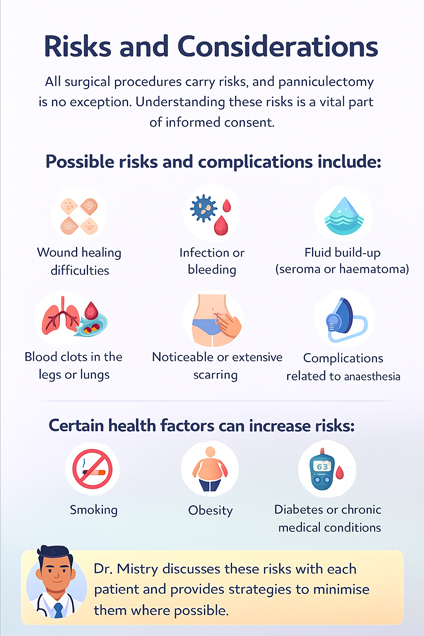
All surgical procedures carry risks, and panniculectomy is no exception. Understanding these risks is a vital part of informed consent.
Numbness or altered sensation in the abdominal skin
Complications related to anaesthesia
Certain health factors can increase risks. Smoking, obesity, and chronic medical conditions such as diabetes are associated with slower wound healing and higher complication rates. Dr. Mistry discusses these risks with each patient and provides strategies to minimise them where possible.
Why Choose a Specialist Plastic & Reconstructive Surgeon in Newcastle
Choosing a surgeon with recognised qualifications and hospital accreditation is an important part of preparing for panniculectomy.
Dr. Yezdi Mistry is a Specialist Plastic & Reconstructive Surgeon who holds FRACS in Plastic Surgery. He has extensive experience in reconstructive abdominal procedures and provides care from his Charlestown practice in Newcastle. His approach is centred on patient safety, evidence-based treatment, and thorough follow-up care.
For patients considering panniculectomy, working with a qualified Specialist Plastic & Reconstructive Surgeon offers reassurance that the procedure will be planned and carried out in line with current surgical standards.
Next Steps
If you are experiencing discomfort or health concerns related to excess abdominal tissue and would like to learn more about panniculectomy, Dr. Yezdi Mistry welcomes you to book a consultation at his Charlestown clinic in Newcastle. As a Specialist Plastic & Reconstructive Surgeon, he will assess your individual needs, explain the procedure in detail, and discuss whether panniculectomy may be suitable for you.
Make an Enquiry Today
FAQs About Panniculectomy
How is panniculectomy different from abdominoplasty?
Panniculectomy removes the pannus – the overhanging fold of abdominal skin and tissue – without tightening the abdominal muscles. Abdominoplasty involves both skin removal and muscle repair. Panniculectomy is focused on functional improvement, not abdominal contouring.
Will panniculectomy help with back or posture issues?
Some patients in Newcastle find that removing the pannus reduces discomfort when standing or walking. However, panniculectomy is not designed to correct posture or spine alignment. Any improvement in comfort varies between individuals.
How long should I have maintained my weight before surgery?
Dr. Mistry generally advises that patients should have a stable weight for at least 6–12 months before considering panniculectomy. Stability reduces the risk of recurrence of excess skin and supports safer healing.
What kind of scarring can I expect?
Scarring from panniculectomy is permanent and usually extends across the lower abdomen, sometimes with a vertical scar if more tissue needs to be removed. Scars may fade over time but remain visible. Dr. Mistry provides guidance on scar care during recovery.
Can panniculectomy be combined with other procedures?
In some cases, panniculectomy may be performed at the same time as other abdominal or gynaecological operations. However, combining procedures can increase surgical risks. Dr. Mistry will advise whether this is appropriate based on the patient’s health and goals.
When will I be able to return to work after surgery?
This depends on the type of work and individual healing. Some patients return to light duties within 4–6 weeks, while others may need longer. Dr. Mistry will provide guidance during follow-up visits based on recovery progress.
Is panniculectomy suitable for both men and women in Newcastle?
Yes. Both men and women who experience excess abdominal skin and related symptoms may be candidates for panniculectomy. Dr. Mistry has treated a wide range of patients at his Charlestown clinic, tailoring the procedure to each person’s needs.
Medical References
Clinical and perioperative outcomes of abdominal wall reconstruction combined with panniculectomy – Published 2025 – Study from a high-complexity center in Bogotá, Colombia on safety and benefits of combined ventral hernia repair and panniculectomy. https://pmc.ncbi.nlm.nih.gov/articles/PMC12279593/
Postpanniculectomy Improvement in Low Back Pain – Published 2024 – Article from a medical journal demonstrating functional improvements after panniculectomy surgery. https://pmc.ncbi.nlm.nih.gov/articles/PMC11626547/
Fill in your details and our friendly team will be in touch with you
Please Note: Information provided on Dr Mistry’s website is provided as a basic guide, it does not constitute a diagnosis and should not be taken as medical advice. Any surgical or invasive procedure carries risks.
A Newcastle Surgeon That Cares
“I care because it’s my job as a surgeon, as a plastic surgeon, to do the appropriate thing and to give you a good outcome. I want to leave knowing that I can tell a patient, hand on heart, that I did the very best I could and that I looked after them, so when I see them post op later that day or the next morning, that they feel they were in good hands.”