
Basal Cell Carcinoma (BCC) Newcastle
BCC is a slow-growing skin cancer caused mostly by long-term sun exposure.
This procedure may be considered by people with heavy sun exposure and with weakened immune systems.

This procedure may be considered by people with heavy sun exposure and with weakened immune systems.
Basal Cell Carcinoma (BCC) is the most common form of skin cancer diagnosed in Australia, with thousands of new cases treated each year. It typically grows slowly and, when detected early, can be effectively managed with surgical excision or other established medical techniques. Although it rarely spreads to distant parts of the body, untreated BCC can progressively invade deeper tissues and cause significant local destruction, particularly in delicate or functional regions such as the eyelids, nose, lips, and ears.
At Dr Mistry Specialist Plastic Surgeon, located within the Charlestown Healthcare Hub, Dr Yezdi Mistry (BHB, MBChB, FRACS (Plastic Surgery), Registration No. MED0001861566) offers comprehensive care for patients requiring the removal and reconstruction of skin cancers, including Basal Cell Carcinoma. His practice serves individuals from Charlestown, Newcastle, Lake Macquarie, and the Hunter Region, providing a balance of oncologic precision and reconstructive planning to support both function and appearance.
Treatment for BCC is primarily oncologic and reconstructive in nature. The procedure aims to remove the tumour with an appropriate margin of healthy tissue to ensure full excision, while also reconstructing the affected area to protect nearby anatomical functions such as blinking, nasal airflow, speech, or swallowing. Depending on the size, subtype, and position of the lesion, surgery may be performed in an accredited day surgery setting under local anaesthetic, or in hospital when more complex closure or flap reconstruction is required.


Basal Cell Carcinoma arises from the basal cells within the epidermis, which is the skin’s outermost layer. Prolonged and cumulative exposure to ultraviolet (UV) radiation from sunlight is the most significant cause. Over time, DNA damage to skin cells can lead to mutations that cause abnormal cell growth, resulting in a visible lesion.
BCC often develops on sun-exposed areas such as the face, scalp, neck, shoulders, arms, and upper torso. However, it may also occur on less-exposed sites, particularly in individuals with fair skin or a history of intermittent intense sun exposure. The condition can present in several patterns. Nodular BCC is the most common and often appears as a pearly lump with small surface blood vessels. Superficial BCC tends to form flat, scaly, red patches that can resemble eczema or dermatitis. Morphoeic or infiltrative BCC may appear as a pale, scar-like area that subtly blends into surrounding skin, sometimes making early detection challenging.
While BCC rarely metastasises to distant organs, it can grow locally and invade deeper layers of skin, cartilage, muscle, or bone. This can cause disfigurement or functional problems if left untreated. The primary goal of management is early diagnosis, complete removal, and appropriate reconstruction. The intended outcomes include complete cancer clearance, minimisation of recurrence risk, and restoration of both function and appearance in the treated area.
Individuals who may require treatment for BCC are typically those who have noticed a persistent lesion that bleeds, crusts, or fails to heal within a few weeks. A pearly bump, rolled edge, central ulcer, or patch of skin that feels waxy or scarred may also indicate a Basal Cell Carcinoma. Many people are referred to a plastic surgeon after their general practitioner or dermatologist performs a biopsy confirming the diagnosis.
Treatment may also be indicated for recurrent BCCs—tumours that reappear in an area previously treated. These often require more complex surgery to ensure complete clearance. People with significant sun exposure, fair skin, light-coloured eyes, and a tendency to sunburn easily are at increased risk. Those with weakened immune systems, such as organ transplant recipients or patients undergoing immunosuppressive therapy, also require close monitoring.
Because BCC may appear subtle in its early stages, it is important for anyone with a suspicious lesion, especially on the face, scalp, or other high-risk areas, to seek prompt medical assessment. The decision to proceed with treatment depends on several factors including the tumour’s type, location, size, and any previous history of skin cancer. Each case is evaluated individually to ensure management aligns with best practice standards and the patient’s health profile.
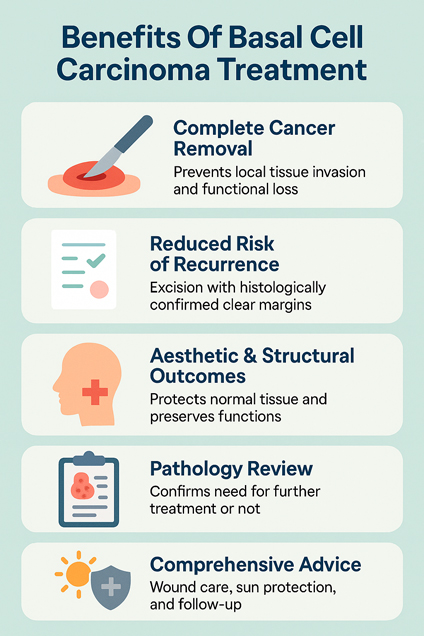
Timely treatment of Basal Cell Carcinoma provides the critical benefit of complete cancer removal, which prevents local tissue invasion and functional loss.
Excision with histologically confirmed clear margins significantly reduces the risk of recurrence, offering long-term disease control. When undertaken by a qualified Specialist Plastic and Reconstructive Surgeon, treatment planning also considers aesthetic and structural outcomes, especially in regions that affect facial expression, vision, breathing, or speech.
By excising the lesion and reconstructing the area thoughtfully, treatment aims to protect normal tissue and preserve essential functions. The pathology review following surgery confirms whether the cancer has been entirely removed or whether further treatment is needed. Patients can also expect comprehensive advice on wound care, sun protection, and follow-up, contributing to sustained skin health.
As Basal Cell Carcinoma management is a medical and reconstructive procedure, public display of before-and-after photographs is not a standard part of care. Any educational imagery used for consultation purposes is strictly compliant with AHPRA advertising regulations. These images, when shown during a private appointment, are intended solely to illustrate the reconstructive options available for individual cases rather than to promote cosmetic outcomes.
When you attend a consultation with Dr Yezdi Mistry in Charlestown, the focus is on providing a clear understanding of your diagnosis, the available treatment approaches, and what to expect throughout the process.
The consultation begins with a detailed review of your medical and surgical history, including any previous skin cancer treatments, medications, allergies, and general health factors that could influence healing. The biopsy report is reviewed carefully, as it provides important information about the cancer’s subtype and depth.
Dr Mistry then conducts a thorough clinical examination of the affected area. This includes evaluating the lesion’s size, margins, and proximity to vital structures. Where appropriate, dermatoscopic assessment or review of medical imaging may assist in defining the extent of the lesion. If other suspicious spots are present, these will be noted for further assessment.
After the assessment, Dr Mistry explains the surgical plan in detail, discussing the margin required for excision, the most appropriate closure technique, and the potential need for flap or graft reconstruction. For certain lesions, particularly those in delicate facial regions or previously treated sites, Dr Mistry may coordinate care with a dermatologist who performs Mohs micrographic surgery to ensure complete margin control.
The consultation also includes an outline of the recovery process, expected downtime, and follow-up appointments. Patients are encouraged to ask questions and take the time they need to understand their treatment fully before proceeding.
Treatment for Basal Cell Carcinoma is most often performed under local anaesthetic in an accredited day surgery setting. However, larger or more complex lesions, particularly those requiring intricate reconstruction, may necessitate sedation or general anaesthetic in hospital.
The surgical process begins with precise planning and marking of the lesion, ensuring an adequate margin of normal tissue is included. For small, well-defined tumours, margins of approximately three to four millimetres are generally sufficient. For more aggressive or infiltrative subtypes, wider margins may be required.
Once anaesthesia has taken effect, Dr Mistry removes the lesion and any surrounding tissue planned for excision. The specimen is carefully labelled and sent for pathology to confirm clear margins. Reconstruction follows immediately after excision and may involve direct closure, local flap advancement, or the use of a skin graft, depending on the site and size of the defect.
When Mohs micrographic surgery is part of the plan, the tumour is removed layer by layer, with each layer examined under a microscope until all cancer cells have been cleared. After confirmation of clear margins, Dr Mistry performs the reconstructive component, which may include local tissue rearrangement or grafting to optimise both functional and aesthetic results.
For some superficial BCCs or cases where surgery is contraindicated, alternative treatments such as topical creams, cryotherapy, or radiotherapy may be considered following multidisciplinary consultation.
Recovery varies depending on the site and complexity of surgery. In the first few days after the procedure, it is normal to experience mild swelling, bruising, and localised tenderness. Dressings should remain intact and dry as instructed. Dr Mistry and his nursing team provide clear written and verbal instructions regarding wound care and follow-up appointments.
Stitches are typically removed within one to two weeks, depending on the area. During this period, patients should avoid strenuous activity and heavy lifting to prevent wound tension. Many patients return to desk-based work within several days, while those with more complex closures may require a longer period before resuming full activity.
As the wound heals, scar maturation occurs over several months. Scar care and sun protection are vital to maintain optimal healing. Regular application of broad-spectrum SPF50+ sunscreen and the use of protective clothing are strongly advised. Patients are also encouraged to attend routine skin checks, as those who have had one Basal Cell Carcinoma have a higher likelihood of developing additional skin cancers in the future.
All medical procedures carry some level of risk. For Basal Cell Carcinoma treatment, potential complications include bleeding, infection, delayed wound healing, scarring, changes in skin sensation, or recurrence of cancer if any microscopic cells remain. More complex reconstructions may occasionally experience flap or graft complications requiring further attention.
Anaesthetic-related risks depend on the type of anaesthesia and the individual’s overall health. Some patients may experience temporary numbness, tightness, or asymmetry at the surgical site during the healing phase. Dr Mistry discusses all relevant risks prior to surgery to ensure that each patient is well-informed and comfortable with the plan.
The total cost of BCC treatment varies depending on factors such as the complexity of the procedure, the need for reconstruction, and whether it is performed under local or general anaesthetic. The overall cost generally comprises the surgeon’s professional fee, hospital or day surgery charges, anaesthetist’s fee (if applicable), and pathology charges for histological analysis.
Following your consultation, a detailed written estimate is provided outlining these components. For general information about what is included, please visit the Fees & Costs section of the Dr Mistry Specialist Plastic Surgeon website.
When treatment is clinically required for a confirmed Basal Cell Carcinoma, aspects of the procedure may attract Medicare rebates under the Medicare Benefits Schedule (MBS). If the procedure is performed in a private hospital, eligible patients with private health insurance may receive additional support for hospital and theatre costs, depending on their policy.
Dr Mistry’s administrative team provides detailed guidance on which aspects of your care are eligible for rebates and assists in preparing itemised cost summaries. Patients are encouraged to confirm coverage details directly with their health fund before surgery.
Dr Yezdi Mistry is a Specialist Plastic and Reconstructive Surgeon with FRACS (Plastic Surgery) and registration number MED0001861566. He has extensive experience in managing both simple and complex skin cancers, with a focus on precision, reconstructive integrity, and patient safety.
Dr Mistry serves as a Visiting Medical Officer in hand and plastic surgery at John Hunter Hospital and established Dr Mistry Specialist Plastic Surgeon at the Charlestown Healthcare Hub to provide comprehensive care to the communities of Charlestown, Newcastle, Lake Macquarie, and the Hunter Region.
Having undertaken advanced international training and continuous professional development, Dr Mistry integrates evidence-based surgical principles with modern reconstructive techniques. His patient-centred approach ensures that each person receives individualised attention, clear explanations, and realistic expectations about the treatment process and recovery.
If you have been diagnosed with a Basal Cell Carcinoma or have a lesion that requires expert evaluation, you are invited to arrange a consultation with Dr Yezdi Mistry, Specialist Plastic & Reconstructive Surgeon. During your visit, Dr Mistry will assess the lesion, explain the treatment options in detail, and outline a tailored plan that prioritises both cancer control and functional restoration.
Dr Mistry Specialist Plastic Surgeon
Charlestown Healthcare Hub
Suite 312, Level 3, 99 Pacific Highway, Charlestown NSW 2290
Phone: (02) 4062 7888
Email: admin@drmistry.com.au
Dr Mistry’s practice proudly serves patients from Charlestown, Newcastle, Lake Macquarie, and the wider Hunter Region, providing evidence-based, compassionate surgical care for skin cancer management.
Basal Cell Carcinoma develops primarily from long-term exposure to ultraviolet (UV) radiation, which damages the DNA in skin cells over time. This cumulative damage leads to abnormal cell growth in the skin’s basal layer. Individuals with fair skin, light-coloured eyes, or a history of sunburns are more likely to develop BCC, although it can occur in all skin types.
A BCC may appear as a pearly or translucent bump, a red scaly patch, or a small sore that repeatedly bleeds or fails to heal. Some may resemble a scar or a shiny flat area. Because BCC can look different depending on its subtype, it’s important to have any persistent or changing lesion examined by a doctor for assessment and possible biopsy.
While BCC rarely spreads to other organs, it can grow locally and invade surrounding tissues if untreated. This may cause damage to deeper structures, especially in sensitive regions such as the nose, eyelids, or lips. Early detection and treatment are key to preventing complications and achieving complete clearance.
Most BCCs are managed surgically by removing the lesion along with a small margin of healthy tissue. The excised tissue is then analysed by a pathologist to confirm that the cancer has been completely removed. Reconstruction may follow immediately to close the wound and restore the area’s appearance and function. Alternative treatments such as topical therapies, cryotherapy, or radiotherapy may be considered for specific cases based on tumour type and site.
Healing depends on the size and location of the excision as well as the method of closure. Minor procedures may heal within one to two weeks, while larger or more complex reconstructions can take several weeks to settle. Scar maturation continues over a number of months, and follow-up appointments allow for monitoring of healing progress.
Recurrence is possible, especially for high-risk or previously treated BCCs. Ensuring adequate surgical margins and ongoing follow-up with your surgeon or dermatologist helps reduce this risk. Sun protection, skin self-checks, and professional skin examinations are also recommended for long-term prevention and early detection.
Prevention focuses on reducing UV exposure. Regular use of broad-spectrum SPF50+ sunscreen, wearing protective clothing, hats, and sunglasses, and seeking shade during peak sun hours are all effective measures. Routine skin checks, especially for those with previous skin cancers or high sun exposure, are also strongly advised.
Fill in your details and our friendly team will be in touch with you
Please Note: Information provided on Dr Mistry’s website is provided as a basic guide, it does not constitute a diagnosis and should not be taken as medical advice. Any surgical or invasive procedure carries risks.


“I care because it’s my job as a surgeon, as a plastic surgeon, to do the appropriate thing and to give you a good outcome. I want to leave knowing that I can tell a patient, hand on heart, that I did the very best I could and that I looked after them, so when I see them post op later that day or the next morning, that they feel they were in good hands.”
– Dr Yezdi Mistry
Request a Consult