
This procedure is beneficial for people who have a split, stretched, gauged, irregular, or scarred earlobe from piercings or trauma.
Earlobe repair, also referred to as split earlobe reconstruction or lobuloplasty, is a minor surgical procedure performed to address a torn or stretched earlobe. Although the earlobe is a small structure, it contributes significantly to the balance and shape of the ear. When the delicate tissue becomes torn or elongated, it can make wearing earrings difficult and may alter the appearance and balance of the lobe. At Dr Mistry Specialist Plastic Surgeon in Charlestown, Dr Yezdi Mistry offers earlobe repair for patients from Newcastle, Charlestown, Lake Macquarie and the Hunter region.
This procedure is primarily reconstructive but often also provides aesthetic modification by re-establishing a natural outline and symmetry between the ears. For most people, it is performed under local anaesthesia as a day procedure. Earlobe repair helps restore tissue continuity, reduce visible irregularity and, after appropriate healing, may allow re-piercing at a new position if desired. The technique is carefully tailored to each person’s anatomy, with the aim of achieving a harmoniousl appearance and durable result.
Earlobe repair is a minor surgical procedure designed to correct a lobe that has been torn completely or partially, or that has become stretched over time. The earlobe is composed mainly of soft skin and fatty tissue without cartilage support. Because of this softness, it is more vulnerable to injury from repeated tension or sudden pulling. Common causes of damage include wearing heavy earrings for long periods, accidental tugs when clothing or hair becomes caught, use of large-gauge piercings, or trauma from sports or other physical activities.
During the repair, Dr Mistry carefully removes the thin layer of scar tissue surrounding the damaged piercing tract. This allows the healthy edges of the lobe to heal together. Depending on the direction and size of the split, different surgical patterns can be used. In a straightforward case, the tract is excised and the edges are sutured directly. Where the tear extends to the lower edge, a small wedge of tissue may be removed to maintain a rounded contour. For more complex cases, small local flaps or a Z-plasty technique may be used to prevent notching at the lower border and to restore an even curvature.
The intention is to close the defect securely while preserving the natural thickness of the earlobe. In partial splits, where some of the piercing tract remains intact, Dr Mistry may discuss whether it is possible to preserve part of the tract or whether complete closure and later re-piercing would provide a more durable result. In every case, meticulous attention is paid to symmetry, alignment of skin edges, and fine suturing to encourage a subtle scar.
Earlobe repair may be suitable for people of any age who have experienced a tear or elongation of the ear-piercing tract. Some patients have a complete split where the earring hole has extended to the lower edge of the lobe, while others notice a partial tear with a very thin bridge of skin remaining. Others may have progressive stretching from heavy jewellery or gauges. The procedure may also be considered for those who have irregularity after trauma, a laceration from an accident, or changes in contour following previous repair.
In certain occupations or activities, such as healthcare, sports or performing arts, a damaged earlobe may interfere with wearing headsets, protective equipment or masks. Repairing the lobe may restore comfort and reduce the likelihood of further tearing. Individuals who no longer wish to wear stretched jewellery may also choose this procedure to allow the tissue to close and heal naturally.
During consultation, Dr Mistry assesses the condition of the skin, presence of scar tissue and thickness of the remaining lobe to determine the best approach. Patients are encouraged to have stable general health and to disclose any factors that could affect healing, such as diabetes, smoking or medications that thin the blood.
Although a small operation, earlobe repair can provide meaningful improvement in the function and appearance of the ear. By closing a tear or stretched piercing, the procedure restores the lobe’s continuity and smooth edge. Many patients appreciate the ability to wear earrings again after the recommended healing period, while others simply value having the tissue repaired so it no longer catches on clothing or causes discomfort.
Repairing the earlobe can also prevent further enlargement of the defect. Once a split begins, it rarely heals without surgery and may gradually extend with continued earring use. Surgical repair removes the scarred edges and re-aligns the tissue to encourage strong healing. The refined contour achieved through precise closure may also help the ears appear balanced, especially when both sides have been affected.
As with all reconstructive procedures, the extent of improvement depends on individual factors including tissue quality, the size of the tear, previous surgery, and adherence to aftercare instructions. Dr Mistry provides realistic expectations and explains what can and cannot be achieved during your consultation.
Earlobe repair can have aesthetic outcomes, and photographs can be a useful way to understand the expected changes. To comply with AHPRA advertising guidelines, before-and-after photographs are only shown during private consultation or within the clinic setting where appropriate context can be provided. These images demonstrate typical examples of tissue repair and scar positioning but are never presented as promises or guarantees of results. They are carefully standardised for lighting, posture and framing to ensure that differences are accurately represented.
Your consultation with Dr Yezdi Mistry takes place at the Charlestown Healthcare Hub, where the environment is designed for privacy and detailed discussion. The appointment begins with a review of your medical history, medications, previous ear injuries and any prior procedures. Understanding your background helps confirm the safest and most suitable plan. Dr Mistry will then examine the ear closely, noting the thickness of the lobe, the position of the split, the quality of the skin, and how the ear shape relates to the opposite side.
This assessment allows him to recommend the most appropriate surgical method. He will explain each step, including the type of anaesthesia, where the incision will be placed, and how the edges will be closed. The consultation is an opportunity to ask questions about healing time, aftercare and possible risks. Dr Mistry will also outline the expected time before re-piercing can be considered.
Each patient receives written information about the procedure and recovery, ensuring informed consent consistent with the Royal Australasian College of Surgeons (RACS) standards. This careful planning process helps patients make decisions that align with their individual circumstances and expectations.
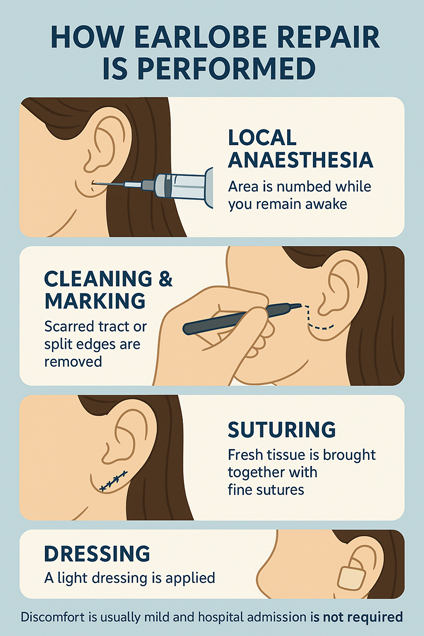
Earlobe repair is typically performed under local anaesthesia, which numbs the area while you remain awake. The procedure may take between thirty minutes and one hour, depending on whether one or both lobes are treated and how extensive the damage is. Because only a small amount of anaesthetic is needed, you can usually leave the clinic shortly after the procedure.
Once the area is cleaned and anaesthetised, Dr Mistry marks the planned incisions to ensure the correct alignment. The scarred tract or split edges are then carefully removed to expose fresh, healthy tissue. This is an essential step, as it allows the wound edges to heal together smoothly. The layers of the lobe are then brought together using fine sutures. These stitches are placed precisely to minimise tension on the skin and to recreate the natural curve of the earlobe.
When the repair involves the lower border of the lobe, Dr Mistry may reshape the edge slightly to restore its rounded contour. In certain cases, he may use small flap or Z-plasty techniques to distribute tension and reduce the risk of notching as the wound heals. After the closure is complete, a light dressing is applied to protect the site.
Patients generally find that the anaesthetic wears off after a few hours. Discomfort during recovery is usually mild and can be managed with simple analgesia if required. Because the procedure is minor, hospital admission is not usually necessary.
Recovery following earlobe repair is relatively straightforward, though it still requires care and patience to achieve the best result. The first day or two are usually associated with mild swelling and tenderness, which gradually subside. The dressing should be kept dry, and the area protected from accidental knocks. Dr Mistry will provide detailed written instructions on cleaning the incision and managing the dressing.
Stitches are typically removed at around one week, though this may vary depending on the technique used. During this early period, it is important to avoid sleeping on the repaired ear and to refrain from wearing earrings or headphones that put pressure on the lobe. Most people can return to work or regular activities soon after surgery, but contact sports or activities that risk trauma should be postponed until healing is complete.
Over the following weeks, the scar continues to strengthen. The colour gradually fades, and any firmness in the area softens. Dr Mistry may recommend gentle scar massage or silicone products once the wound has closed. Full maturation of the scar can take several months. Re-piercing is generally delayed for a few months, and it is advised to position the new piercing away from the scar line to reduce the chance of recurrence.
Healing times can differ from person to person. Factors such as smoking, diabetes, or previous scarring may influence recovery. Dr Mistry’s team will schedule follow-up appointments to monitor progress and provide guidance at each stage.
Every surgical procedure carries inherent risks. Although earlobe repair is a minor operation, patients should be aware of potential complications so that they can make an informed decision. Possible issues include bleeding or haematoma, infection, delayed healing, and thickened or stretched scarring. Occasionally, small irregularities such as notching or slight asymmetry between the ears can occur.
A recurrent split may develop if significant tension is placed on the lobe before full healing has occurred or if heavy earrings are used later. Some individuals may experience temporary or persistent numbness in the treated area, which generally improves with time. Very rarely, further minor revision may be needed to refine the contour or correct notching.
Dr Mistry discusses all of these considerations during your pre-operative consultation. Patients also receive written information outlining the general surgical risks, consistent with the RACS guidelines for informed consent. Careful adherence to aftercare instructions and attendance at follow-up visits reduce the likelihood of complications.
The cost of earlobe repair varies depending on the extent of the repair and the circumstances of each case. Fees are influenced by whether one or both lobes are involved, whether the tear is partial or complete, and whether this is a first-time repair or a revision. Other factors include the type of anaesthesia used, the facility where the procedure is performed, and the required aftercare and dressings.
Because each procedure is individual, the practice does not publish specific dollar amounts online. During your consultation, the team will provide a detailed written estimate that includes the surgeon, anaesthetist (if applicable), and facility fees. Further information about inclusions is available in the Fees & Costs section on our website or directly from our administrative staff.
In most situations, earlobe repair is considered a self-funded procedure, as it is commonly requested for long-standing piercing splits or stretching rather than recent trauma. Medicare and private health funds generally do not cover costs when the repair is performed for aesthetic or convenience reasons.
However, if the repair is required after an acute injury or is part of reconstruction following lesion removal, a Medicare item number may apply provided the clinical criteria are met. Eligibility is determined based on the nature of the injury and the documentation supplied by your surgeon. Our staff can advise which reports or photographs may be needed if you wish to check your potential benefits with your insurer.
For up-to-date information about eligible procedures, you may wish to review the MBS Online database or consult Services Australia. Dr Mistry’s team can guide you on how to obtain this information but cannot provide financial or insurance advice.
Dr Yezdi Mistry is a Specialist Plastic and Reconstructive Surgeon with extensive training and experience in reconstructive and aesthetic surgery of the face and body. After completing his FRACS (Plastic Surgery) qualification through the Royal Australasian College of Surgeons, Dr Mistry established his private practice in Charlestown, where he treats patients from Newcastle, Lake Macquarie and the Hunter region. He also serves as a Visiting Medical Officer in hand and plastic surgery at John Hunter Hospital, reflecting his ongoing commitment to both public and private patient care.
Dr Mistry participates regularly in national and international professional development programs to ensure his techniques remain aligned with current evidence and safety standards. He has undertaken advanced training at the Body Contouring Academy in Paris, and his practice incorporates technologies such as VASER and RENŪVION where clinically appropriate.
Above all, Dr Mistry’s approach is centred on professionalism, clarity and collaboration. From the first consultation through to follow-up, patients are encouraged to ask questions and to participate actively in decision-making. Each treatment plan is personalised, reflecting the individual’s medical history, goals and expectations. The Charlestown clinic maintains a calm and respectful environment, following AHPRA and RACS guidelines for advertising and patient communication.
If you are considering earlobe repair in Newcastle or the Hunter region, or wish to discuss the repair of a torn or stretched earlobe, you are welcome to arrange a consultation with Dr Yezdi Mistry at his Charlestown rooms. During your appointment, Dr Mistry will assess the condition of your earlobes, explain the available techniques, and outline the expected recovery and aftercare program. You will receive a comprehensive treatment plan tailored to your needs.
Appointments can be arranged by contacting Dr Mistry Specialist Plastic Surgeon at the Charlestown Healthcare Hub, Suite 312, Level 3, 99 Pacific Highway, Charlestown NSW 2290. The clinic can be reached by phone on (02) 4062 7888 or by email at admin@drmistry.com.au. Dr Mistry welcomes patients from Charlestown, Newcastle, Lake Macquarie and across the Hunter region, and is committed to providing detailed, individualised care in a professional and supportive environment.
Most procedures take around 30 to 60 minutes, depending on the extent of the tear and whether one or both lobes are treated.
The procedure is performed under local anaesthesia, which numbs the area so that patients feel no discomfort during surgery. Any mild tenderness afterwards can usually be managed with over-the-counter pain relief.
Yes, both lobes can be repaired in the same appointment if clinically appropriate. Dr Mistry will discuss this option during consultation.
A fine scar remains after earlobe repair, though it usually fades with time. Dr Mistry uses meticulous suturing techniques and provides scar care guidance to support optimal healing.
Re-piercing is generally considered several months after repair, once the lobe has fully healed. The new piercing should be placed away from the scar line.
The repair is designed to be long-lasting. However, future trauma or use of heavy earrings can cause new tears, so gentle care is recommended.
• Esthetic and reconstructive options for earlobe deformities – Journal of Cutaneous and Aesthetic Surgery (JCAS) – https://www.ncbi.nlm.nih.gov/pmc/articles/PMC3283920/
• Repair of Gauged Earlobes: Case Series and Review – PubMed Central (PMC) – https://www.ncbi.nlm.nih.gov/pmc/articles/PMC7791282/
• A Revised Classification and Treatment Algorithm for Acquired Split Earlobe – Cureus Journal of Medical Science – https://www.ncbi.nlm.nih.gov/pmc/articles/PMC7532232/
• Split Ear Lobe Repair: Literature Review and New Technique – Brazilian Journal of Plastic Surgery (SciELO) – https://www.scielo.br/j/bjps/a/xx
• Earlobe Cleft Reconstructive Surgery – Brazilian Journal of Otorhinolaryngology (Elsevier) – https://www.elsevier.es/en-revista-brazilian-journal-otorhinolaryngology-261
• Surgical Correction of the ‘Split’ Earlobe – The PMFA Journal – https://thepmfajournal.com/article/split-earlobe-repair-2023
• Split Ear, Blood Group Association – International Journal of Otorhinolaryngology and Head and Neck Surgery – https://www.ijorl.com/article/split-ear-blood-group-association
Fill in your details and our friendly team will be in touch with you
Please Note: Information provided on Dr Mistry’s website is provided as a basic guide, it does not constitute a diagnosis and should not be taken as medical advice. Any surgical or invasive procedure carries risks.




“I care because it’s my job as a surgeon, as a plastic surgeon, to do the appropriate thing and to give you a good outcome. I want to leave knowing that I can tell a patient, hand on heart, that I did the very best I could and that I looked after them, so when I see them post op later that day or the next morning, that they feel they were in good hands.”
– Dr Yezdi Mistry
Request a Consult