GP Referrals: Bridging your primary care and specialist assessment for coordinated, Medicare-eligible treatment.
A GP referral benefits any patient seeking specialist care by ensuring their medical history is accurately communicated to the surgeon, enabling access to Medicare rebates for consultation fees, and maintaining coordinated care between their local doctor and the specialist.
If you are considering a consultation with a Specialist Plastic and Reconstructive Surgeon, understanding how GP referrals work in Australia can make the process clearer and reduce avoidable delays. At Dr Mistry Specialist Plastic Surgeon in Charlestown, New South Wales, Dr Yezdi Mistry – Specialist Plastic and Reconstructive Surgeon (BHB, MBChB, FRACS (Plastic Surgery) | Registration No. MED0001861566) consults with patients from Charlestown, Newcastle, Lake Macquarie, and across the Hunter region for a wide range of concerns that may be reconstructive, functional, or appearance-related.
A GP referral is not a procedure, but it is an important clinical document that supports coordinated care between your general practitioner and your specialist. In many circumstances, a valid referral is also required for Medicare benefit arrangements for specialist consultations. Referral rules include how long a referral remains valid and when a new referral is required, so it is helpful to understand the pathway before you book an appointment. Services Australia explains that a GP referral to a specialist typically lasts 12 months from the date of your first specialist attendance, unless a different period is specified, and that a GP can refer beyond 12 months or indefinitely when ongoing care is needed.
What Is A GP Referral?
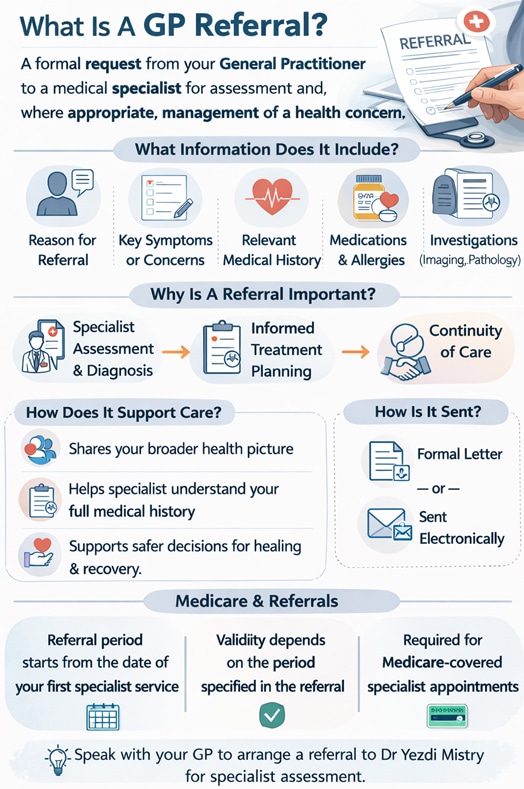
A GP referral is a formal request from your general practitioner to a medical specialist for assessment and, where appropriate, management of a particular health concern. Referrals can be provided as a letter or sent electronically, and they usually include information your specialist needs to understand the clinical context of your appointment. This commonly involves the reason for referral, key symptoms or concerns, relevant medical history, medications, allergies, and results of investigations such as imaging or pathology where available.
A referral also supports continuity of care. Your GP is often the clinician who knows your broader health picture, including conditions that can affect healing and recovery, such as diabetes, cardiovascular disease, smoking status, nutrition, and medication use. When your GP and specialist share relevant information, it can help ensure decisions are made with a clear understanding of your overall health, not just the local issue being assessed.
From an administrative perspective, referrals also link to Medicare rules for specialist services. The Medicare Benefits Schedule notes that the referral period is taken to commence from the date of the first specialist service covered by that referral, and that referral validity depends on the period specified in the referral.
Who May Consider Seeking A GP Referral?
People seek GP referrals for many reasons, and the most suitable referral pathway depends on the individual concern, your health history, and whether specialist assessment is clinically appropriate at that stage. In the context of plastic and reconstructive surgery, referrals commonly relate to reconstructive needs, functional problems, or appearance-related concerns that a person wants assessed with specialist input.
Some patients speak with their GP because they have a reconstructive concern. This may include review after treatment for skin cancer where a reconstruction is required or has been performed, concerns following trauma or injury, evaluation of complex scarring, or discussion of tissue problems related to previous surgery. In these settings, the priority is often to assess what is happening anatomically and medically, what options may exist, and what outcomes are realistic based on the individual situation.
Other patients seek referral for functional concerns, where symptoms are linked to anatomy, scar behaviour, or soft tissue changes. Depending on the presentation, this may involve discomfort, recurrent irritation, difficulties with hygiene, or limitation in day-to-day activities. A GP can help determine whether initial non-operative steps are appropriate, whether investigations should be organised first, or whether early specialist review is sensible.
Some people also request a referral because they want a medically grounded discussion about an appearance-related concern. In this context, a referral supports a consultation focused on anatomy, suitability, informed consent, limitations, potential risks, and expected recovery stages. It is also an opportunity to discuss whether non-operative options are appropriate, whether a procedure may be considered, or whether no intervention is recommended.
Across all of these scenarios, it is important to understand that a referral does not mean surgery is necessary or planned. A referral is simply the pathway to specialist assessment so that next steps can be discussed based on your history, examination findings, and relevant investigations.
Benefits Of Obtaining A GP Referral
A well-prepared GP referral can make your specialist appointment more efficient and clinically useful. When the referral clearly explains the reason for referral and includes relevant details such as your medical history, medications, allergies, and previous investigations, it reduces the chance that the first appointment becomes primarily an information-gathering exercise. Instead, more time can be spent on careful assessment, discussion of options, and planning what should happen next.
A referral also supports ongoing communication between clinicians. The Royal Australian College of General Practitioners (RACGP) emphasises that effective referral practices support access to specialist care and that accurate information in a referral helps continuity of care, including the expectation that patients return to their GP for ongoing management alongside referred services. This matters because even when a specialist is involved, your GP remains central to broader health management, medication review, and monitoring of any issues that may affect treatment decisions.
Another practical benefit is that a referral helps align your care with Medicare requirements when Medicare benefits apply. Services Australia explains referral periods and notes that referrals generally last 12 months from the first specialist attendance unless specified otherwise, and that longer or indefinite referrals may be written when ongoing care is required. Understanding these rules can help reduce interruptions to follow-up planning, particularly when ongoing review is clinically appropriate.
What To Expect During Your Specialist Consultation
A specialist consultation is the place where your concern is assessed carefully and options are discussed in a structured, medically appropriate way. At Dr Mistry Specialist Plastic Surgeon in Charlestown, Dr Yezdi Mistry aims to provide an assessment that is thorough, patient-centred, and focused on informed decision-making for patients from Newcastle, Charlestown, Lake Macquarie, and the wider Hunter region.
✓ Reviewing Your Medical History And Your Goals
Your consultation usually begins with review of the referral and a discussion about your concerns in your own words. This includes when the issue began, how it has changed over time, what symptoms you have noticed, and what treatments have been tried. If your goals are reconstructive or functional, the discussion often focuses on symptoms, limitations, and what improvement might be clinically realistic. If your goals are appearance-related, the discussion focuses on what you are hoping to address, what is anatomically possible, and what limitations may apply.
Your broader medical history matters. Conditions such as diabetes, immune conditions, smoking, certain medications, and previous surgery can influence wound healing and risk. This is one reason GP referrals are useful, because they often contain an accurate overview of medical history and current medications.
✓ Physical Assessment And Imaging Where Needed
A physical examination is often required to understand anatomy, tissue quality, scarring, and functional movement where relevant. The extent of examination depends on the concern and is performed respectfully and with clear explanation of what is being assessed. In some cases, imaging or investigations may already exist and can be reviewed. In other cases, further tests may be recommended before a clear plan can be developed, particularly if there is uncertainty about diagnosis or if surgery is being considered.
✓ Options, Expectations, And A Realistic Recovery Discussion
A key part of the consultation is discussion of options. This may include observation, non-operative management, minor procedures, or surgery where clinically appropriate. Where surgery is considered, the discussion covers the likely setting, the general steps involved, the expected stages of healing, and potential risks and complications. The goal is informed consent, which relies on clear, balanced information rather than assumptions or guarantees.
The Step By Step Process To Obtain A GP Referral
Obtaining a referral is usually straightforward, but the details matter. A clear process helps reduce delays and ensures your consultation with Dr Yezdi Mistry in Charlestown is supported by relevant clinical information.
✓ Step One – Book A GP Appointment And Prepare Key Details
Start by booking a standard GP appointment. Before you attend, it can help to gather information that your GP will likely ask about, such as when the issue began, how it has progressed, and what has already been done to manage it. If you have had previous treatment, surgery, or investigations, having dates and locations can help your GP request reports or include relevant details in the referral.
If symptoms fluctuate, consider describing patterns and triggers. For functional concerns, it is useful to explain how the issue affects daily activities or comfort. For reconstructive concerns, it can help to describe prior procedures or treatments and any current symptoms. For appearance-related concerns, it is helpful to explain what you are hoping to discuss and what information you need to make an informed decision.
✓ Step Two – Your GP Assessment And Initial Management Where Appropriate
Your GP will take a history, examine the area where relevant, and consider whether specialist assessment is appropriate immediately or whether initial management should occur first. Sometimes it is clinically sensible to trial conservative measures or arrange investigations before referral, especially if it helps clarify diagnosis or improves safety before specialist review. In other situations, early specialist assessment is appropriate because the issue is complex, persistent, or requires specialist input to determine options.
✓ Step Three – What A Helpful Referral Usually Includes
A referral works best when it is specific and clinically informative. The RACGP’s guidance on referrals highlights the importance of referral content, choosing the right specialist, and secure communication, with the aim of supporting good referral outcomes for patients. In practical terms, this means the referral clearly states the reason for referral and includes relevant history, medications, allergies, and investigation results where available.
If your GP has ordered imaging or pathology, it helps if the referral notes where the tests were done and attaches or references the reports. If you have had prior surgery, operative summaries can be particularly helpful, because they clarify what was done and what factors may influence further management.
✓ Step Four – Understanding Referral Validity And Timing
Referral validity is one of the most common areas of confusion. Services Australia states that a GP referral to a specialist generally lasts 12 months from the specialist’s first meeting with the patient, unless the referral specifies a different duration, and that a GP can refer beyond 12 months or indefinitely when ongoing care is needed. Services Australia also notes that a new referral is needed if a patient has a new or unrelated condition while on an indefinite referral.
This matters because the clock generally starts from the date of your first specialist attendance, not the date the GP wrote the referral. If you have ongoing follow-up needs, it is sensible to keep track of when your referral period began and to plan ahead if you may need a renewal.
✓ Step Five – Sending The Referral And Booking Your Appointment
Referrals may be sent directly from the GP practice to the specialist rooms via secure electronic systems, or provided to you to forward. If you are forwarding the referral yourself, confirming receipt can prevent delays, particularly if there are attached reports. Once received, the practice team can guide you through appointment scheduling and any additional information that may be helpful to provide before your visit.
If you are located in Charlestown, Newcastle, Lake Macquarie, or elsewhere in the Hunter region, a local referral pathway can also help with logistics such as accessing imaging providers, obtaining copies of results, and coordinating follow-up with your GP close to home.
What Happens After Your Referral Is Sent?
After your referral has been sent, there is usually a period where the practice reviews the referral information, confirms the purpose of the consultation, and schedules your appointment. Timeframes can vary depending on appointment availability and the clinical nature of the referral. If additional information is needed, the practice may request copies of reports or ask your GP to forward specific results so that your consultation can be as productive as possible.
While you are waiting, your GP remains the right point of contact for changes in symptoms or general health concerns. If your symptoms worsen, new symptoms appear, or you develop signs that require urgent assessment, it is important to seek timely medical review rather than waiting for the specialist appointment. This is particularly relevant for concerns such as rapidly changing lesions, suspected infection, severe pain, or systemic symptoms.
Preparing well for your consultation can also help. Bringing an up-to-date medication list, copies of relevant reports if you have them, and a clear set of questions can make the appointment more focused. If your consultation is for an appearance-related concern, it can be helpful to think through what information you need to make an informed decision, including the limitations of surgery, what recovery involves, and how risks apply to your personal health profile.
Potential Administrative Issues And How To Avoid Delays
Even when the clinical pathway is clear, administrative details can affect timing and continuity of care. Understanding common issues can help you avoid unnecessary back-and-forth between clinics.
One common issue is referral expiry. If your referral has lapsed, you may need a renewed referral to continue attending under Medicare arrangements where relevant. Services Australia outlines referral periods and explains that the usual GP referral period is 12 months from first specialist attendance unless otherwise specified. If you expect ongoing care, it can help to diarise your referral start date and speak with your GP about renewal before the referral expires, particularly if you have a planned follow-up schedule.
Another issue is missing information. If a referral does not include key clinical details, or if imaging and pathology reports are not available, the specialist may need to request further information before providing clear recommendations. The RACGP notes the importance of accurate patient information in referrals to support continuity of care and good referral outcomes. A practical approach is to ensure your GP is aware of prior tests and procedures and to confirm where those records are held.
A third issue is scope mismatch, where the referral question does not match the most appropriate specialty for the core problem. Some conditions overlap across specialties, particularly where skin lesions, scarring, pain, or functional symptoms are involved. If this occurs, it usually means the referral needs updating or additional referrals are required. Your GP can help adjust the pathway so that you see the right clinician for the right issue.
Finally, it is worth noting that a referral does not guarantee a particular treatment. The referral starts the specialist assessment process, and the plan is developed after consultation, examination, and review of investigations, with discussion of benefits, limitations, and risks that apply to your individual circumstances.
Costs Associated With GP And Specialist Appointments
Costs can vary depending on the type of appointment and the care required, and it is important to approach this topic in a factual way. A GP appointment may be bulk billed or privately billed depending on your GP clinic’s billing policy. If your GP arranges investigations such as imaging or pathology, there may be additional costs depending on where the tests are performed and whether Medicare arrangements apply.
Specialist consultation fees can vary based on the complexity of the condition, the time required for assessment, and the need to review prior reports and investigations. If further tests are required after the specialist consultation, those investigations may have separate costs. If a procedure is later considered, costs can also be influenced by the surgical setting, facility fees, anaesthesia involvement, and the extent of aftercare required.
For patients of Dr Mistry Specialist Plastic Surgeon in Charlestown, the most accurate information about fees is provided after an individual assessment and discussion of an appropriate plan. This ensures any fee guidance relates to your actual clinical situation rather than assumptions.
Medicare And Private Health Insurance Considerations
Medicare arrangements for specialist consultations commonly require a valid referral, and referral rules influence how long the referral remains active. Services Australia explains referral validity periods, including that a GP referral generally lasts 12 months from first specialist attendance unless otherwise specified, and that longer or indefinite referrals may be appropriate for ongoing care in certain circumstances. The Medicare Benefits Schedule also explains that referral validity is linked to the period specified and is taken to commence from the date of the first specialist service under that referral.
Whether a procedure or course of treatment is eligible for Medicare support depends on the clinical circumstances and the nature of the condition being treated. This can be relevant for reconstructive or functional concerns, but eligibility is assessed case by case and cannot be determined accurately without a specialist consultation and appropriate documentation. For appearance-related procedures, Medicare support is generally not applicable, and this is discussed in a medically appropriate way during consultation where relevant.
Private health insurance considerations vary depending on your level of cover, waiting periods, exclusions, and whether care occurs in a private hospital setting. For the most accurate guidance, it is sensible to speak directly with your health fund using information provided after your consultation, because coverage depends on your individual policy and the specific care being considered.
Why Choose Dr Yezdi Mistry
When choosing a specialist, many patients value clear communication, appropriate qualifications, and a careful approach to informed consent.Dr Yezdi Mistry – Specialist Plastic and Reconstructive Surgeon (BHB, MBChB, FRACS (Plastic Surgery) | Registration No. MED0001861566) is the founder of Dr Mistry Specialist Plastic Surgeon located at Charlestown Healthcare Hub in Charlestown, NSW, supporting patients across Newcastle, Charlestown, Lake Macquarie, and the Hunter region.
Dr Mistry’s approach is grounded in patient-centred care, with consultation discussions focused on understanding the reason for referral, assessing anatomy and health factors, and explaining options in a way that supports informed decision-making. Where a procedure is considered, discussions include realistic expectations, limitations, the likely stages of recovery, and potential risks and complications that must be understood before any decision is made.
Dr Mistry has also worked as a Visiting Medical Officer at John Hunter Hospital, reflecting his involvement in broader specialist practice. He maintains ongoing professional development, including advanced international training such as the Body Contouring Academy in Paris, and may discuss contemporary techniques and technologies, including VASER and RENUVION, when they are clinically relevant and appropriate for an individual patient’s needs and goals.
Make an Enquiry Today
FAQs About How To Get A GP Referral
Do I Always Need A GP Referral To See A Specialist Plastic Surgeon?
Yes. In Australia, you require a valid referral from a GP (or another medical specialist) to see a Specialist Plastic and Reconstructive Surgeon.
This applies whether you are seeking advice for reconstructive surgery or a cosmetic procedure.
A GP referral is important because it:
• Ensures an appropriate medical assessment has been completed
• Provides relevant medical history and background information
• Supports continuity of care between your GP and specialist
• Allows access to Medicare benefits where applicable
What Should I Ask My GP To Include In The Referral?
It is helpful if the referral clearly states the reason for referral and includes relevant medical history, current medications, allergies, and any key test results such as imaging or pathology reports. If you have had previous treatment or surgery related to the concern, noting the details can support a more efficient specialist assessment.
How Long Does A GP Referral Usually Last?
A GP referral to a specialist typically lasts 12 months from the date of your first specialist appointment, unless the referral specifies a different period. If you are unsure whether your referral is still valid, your GP or the specialist rooms can usually help you check.
Can I Use The Same Referral For A Different Concern Later On?
A referral is generally intended for the condition or clinical question described in the referral. If a new or unrelated issue arises, a new referral may be needed so the specialist can assess the new concern under the correct clinical context.
Can I See A Specialist If I Misplace My Referral?
Often, your GP clinic can resend the referral directly to the specialist rooms, especially if it was created electronically. If you think your referral has been lost, contact your GP practice and the specialist rooms to confirm whether it has already been received.
What If My Symptoms Change While I Am Waiting For My Appointment?
If symptoms worsen, new symptoms appear, or you develop signs that need urgent medical attention, you should contact your GP promptly. If the issue is urgent, your GP can advise on the most appropriate next step, which may include expedited assessment through appropriate services.
How Can I Prepare For My Specialist Consultation After I Receive A Referral?
Bring a current medication list, details of relevant medical history, and any available reports from imaging, pathology, or previous procedures. It can also help to write down your main questions so you can discuss options, expected recovery stages, and potential risks in a clear and structured way during your consultation with Dr Yezdi Mistry at Dr Mistry Specialist Plastic Surgeon in Charlestown.
Medical References
Examination of Plastic Surgery Clinical Questions and Responses via an Electronic Consultation (eConsult) Service – Plastic & Reconstructive Surgery Global Open (PMC) – https://pmc.ncbi.nlm.nih.gov/articles/PMC11969479/
Can we Rely on a General Practitioner’s Referral Letter to a Plastic Surgery Skin Lesion Clinic? – Annals of The Royal College of Surgeons of England (PMC) – https://pmc.ncbi.nlm.nih.gov/articles/PMC1963613/
Arrange A Consultation At Dr Mistry Specialist Plastic Surgeon
If you are located in Charlestown, Newcastle, Lake Macquarie, or elsewhere in the Hunter region and would like a specialist assessment, you can speak with your GP about whether a referral is appropriate for your situation and ensure the referral includes relevant medical details and any existing investigation results. If you already have a referral and would like to arrange a consultation with Dr Yezdi Mistry – Specialist Plastic and Reconstructive Surgeon at Dr Mistry Specialist Plastic Surgeon, you can contact the clinic at Charlestown Healthcare Hub, Suite 312, Level 3, 99 Pacific Highway, Charlestown NSW 2290. To make an enquiry or book an appointment, please call (02) 4062 7888or email admin@drmistry.com.au, and the team can guide you on how to submit your referral and prepare for your consultation.
Make an Enquiry with Dr Yezdi Mistry
Fill in your details and our friendly team will be in touch with you
Please Note: Information provided on Dr Mistry’s website is provided as a basic guide, it does not constitute a diagnosis and should not be taken as medical advice. Any surgical or invasive procedure carries risks.
A Newcastle Surgeon That Cares
“I care because it’s my job as a surgeon, as a plastic surgeon, to do the appropriate thing and to give you a good outcome. I want to leave knowing that I can tell a patient, hand on heart, that I did the very best I could and that I looked after them, so when I see them post op later that day or the next morning, that they feel they were in good hands.”