
You may benefit from lipoma treatment if the lump is painful, growing, bothers your appearance, affects movement or nearby structures, or if it’s unclear whether it’s truly a lipoma.
Lipomas are common benign lumps composed of mature fat cells that sit beneath the skin and often feel soft and mobile to touch. While many remain stable for years and require no treatment, others enlarge gradually, become tender with pressure, or interfere with movement and clothing. At Dr Mistry Specialist Plastic Surgeon in Charlestown, Dr Yezdi Mistry provides careful assessment and, when appropriate, surgical removal for adults across Newcastle, Lake Macquarie and the broader Hunter region. Lipoma removal, also known as lipoma excision, is primarily undertaken for functional and diagnostic reasons.
The aims are to confirm the nature of the lump through histopathology, alleviate local symptoms such as tenderness or pressure, and improve day-to-day comfort when a lump rubs under straps, belts or collars or sits near a joint where movement matters. The process is designed to be clear and methodical from the first consultation to follow-up, with treatment tailored to the location and characteristics of each lump and the individual’s health, work, and activity requirements.

A lipoma is a well-circumscribed collection of fat cells enclosed in a thin capsule. Most develop in the subcutaneous layer just under the skin, although some arise within muscle fibres or deeper tissues. The typical lipoma grows slowly over months or years, remains soft, and moves freely beneath the skin when pressed. They can appear anywhere, but are frequently seen on the shoulders, upper arms, back, thighs and neck. The surface of the skin is usually normal, with no redness or punctum, which helps distinguish them from epidermoid cysts. Despite their benign nature, lipomas can be confused with other soft-tissue masses based on feel alone. For that reason, Dr Mistry routinely sends removed tissue for histopathological examination to confirm the diagnosis and exclude rarer conditions that can mimic a lipoma on clinical grounds.
There are recognised variations. Conventional lipomas are composed almost entirely of fat cells. Fibrolipomas include a component of fibrous tissue and may feel a little firmer. Angiolipomas contain small blood vessels and can be tender even when small. Intramuscular lipomas form within muscle and may move less readily with the skin, sometimes producing a deep ache with certain movements. Some people develop more than one lipoma over time; in these cases, individual lumps can be assessed and treated according to symptoms or diagnostic requirements. Although lipomas themselves have no malignant potential, any lump that changes rapidly, becomes unusually firm, feels fixed to deeper tissues, or causes persistent pain deserves timely review, and imaging may be recommended if features are atypical or the lesion is deep.
Many lipomas are simply monitored. When the diagnosis is clear and the lump is small, soft and symptom-free, observation with review if anything changes is a reasonable path. Lipoma removal becomes relevant when the lump affects comfort or function, continues to enlarge, or raises uncertainty about its true nature. People frequently seek assessment for a soft lump that catches beneath clothing or equipment, creates pressure with seatbelts or backpack straps, or limits certain activities such as rowing, swimming, weight training, gardening or manual work. Others notice progressive growth over months or years and wish to address it before it becomes more bothersome. In the forearm, upper back, neck or thigh, a lipoma can press on nearby tissues with specific movements and cause a dull ache or localised tenderness; in these instances, removal may offer practical relief.
During consultation in Charlestown, Dr Mistry considers the size, depth and location of the lump, the presence of tenderness or altered sensation, any previous imaging, and the individual’s medical history, including anticoagulant use, diabetes, smoking, allergies, and prior surgery. A careful physical examination helps differentiate a superficial subcutaneous lump from one that is intramuscular or lies close to important nerves and vessels. If the clinical picture is not fully typical, ultrasound can provide additional detail, and MRI may be used selectively for deep lesions. The decision to proceed is made after discussing the findings, the role of pathology, and the likely recovery for the anatomical site involved.
Surgical excision provides several realistic benefits when performed for appropriate reasons. Many people seek relief from local pressure that makes contact sports, shoulder straps, belts or certain sleeping positions uncomfortable. Where a lump overlaps a joint or lies within muscle, removal may help restore ease of movement and reduce task-specific discomfort.
Another practical benefit is diagnostic certainty. Although the great majority of these lumps are benign, examining the specimen under the microscope confirms the diagnosis and rules out uncommon entities that may resemble lipomas clinically. This confirmation can be particularly reassuring when a lump has changed over time or when imaging suggests deeper involvement. When the entire lump and its capsule are removed, the likelihood of the same lesion returning in that location is reduced. As a secondary effect, the skin surface may look flatter once swelling settles and the incision matures, which can be helpful when a lump has been visible under clothing. Outcomes vary with size, depth, anatomical site and individual healing, and these considerations are discussed before scheduling.
Regarding photographs, lipoma removal is primarily a functional and diagnostic procedure. Where images are useful for education, they can be reviewed with patients during consultation with appropriate context. Any imagery used within the practice follows current AHPRA advertising requirements, including attention to comparability, time frames and captions that avoid misleading impressions. Public-facing galleries are approached conservatively to maintain compliance with Australian regulations.
The first appointment with Dr Mistry is structured to provide clarity. The consultation begins with a detailed discussion of the medical history, including current medications such as antiplatelet or anticoagulant agents, past operations, previous lumps or skin conditions, allergies and any relevant conditions such as diabetes or connective tissue disorders. This is followed by a focused physical examination of the lump to assess size, depth, mobility and the quality of the overlying skin.
The relationship to nearby structures such as tendons, nerves and joint lines is considered, as this influences planning and aftercare. If the lump is deep or atypical, Dr Mistry may recommend ultrasound to characterise its composition and boundary, or MRI if the lesion appears intramuscular or close to critical structures.
Once the assessment is complete, management options are presented in balanced terms. Observation remains appropriate for many small, typical lipomas, and patients who prefer not to proceed can be advised on what changes would prompt review. When removal is considered, the setting, type of anaesthesia and likely duration are explained in plain language. The procedure, the role of sending the specimen to pathology, the expected course of healing, and potential risks are outlined. Written information is provided to take home, and patients are encouraged to ask questions and decide in their own time. For those travelling from the wider Hunter region, the team can coordinate appointments and follow-up to reduce inconvenience.
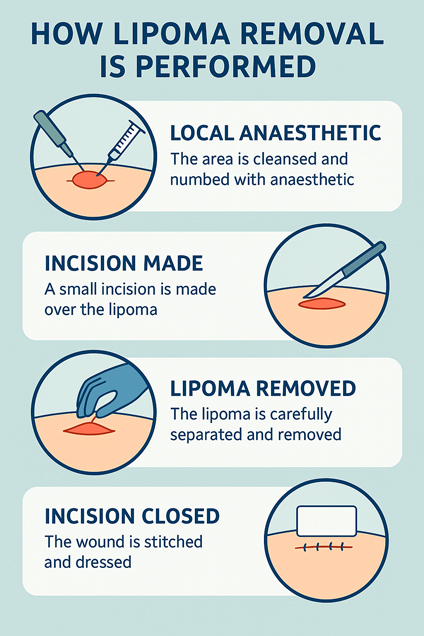
Lipoma excision can be carried out in the Charlestown rooms under local anaesthetic when the lump is small and superficial, or in an accredited day surgery or hospital if it is large, deep, or if several lesions are addressed together. Under local anaesthetic, the area is cleansed and marked while the patient is comfortably positioned. Local anaesthetic is injected to numb the operative field; during the procedure, pressure and movement may be felt but not sharp pain. A small incision is made over the most favourable point, often aligned with the natural skin lines. Through careful dissection, the lipoma is separated from surrounding tissues, preserving nearby structures. The lump and its capsule are removed in one piece where possible. After achieving haemostasis, the wound is closed in layers with fine sutures to support healing, and a sterile dressing is applied. The specimen is then sent for histopathological examination as part of standard care.
When sedation or general anaesthesia is required, a specialist anaesthetist provides care in an accredited facility. This approach is selected for larger or deeper lesions, intramuscular lipomas that require meticulous dissection near nerves or vessels, or situations where addressing multiple sites in one sitting is appropriate. The operative steps are similar, but additional positioning and exposure may be used to improve access and protect surrounding anatomy. Dr Mistry’s technique emphasises gentle handling of tissues, accurate dissection planes, and a neat, layered closure to promote predictable healing. The time taken varies. Many single superficial lipomas can be removed in under an hour from skin preparation to dressing application, while deep or multiple lesions will understandably require longer. The team will provide guidance on fasting, transport home, and postoperative support according to the anaesthesia chosen.
Recovery depends on the size and location of the incision, whether the lump was superficial or intramuscular, and individual health. After local anaesthetic procedures in the rooms, patients generally leave the clinic the same day with written instructions and contact details. Some swelling, bruising and local tenderness are expected for several days. Elevation can be helpful when the procedure involves a limb. Analgesia is usually simple and short term, and the dressing should remain dry unless the team advises otherwise. Showering methods and dressing changes are explained before discharge, and the practice provides guidance for weekends and public holidays.
During the first week, light activities and desk-based work are commonly resumed as comfort allows, while heavy lifting, repetitive strain and stretching that places tension across the incision are best avoided until reviewed. Sutures may be absorbable or removed at a scheduled appointment, depending on the site and closure method. At the first review, Dr Mistry checks that healing is on track and discusses a plan for gradually returning to usual routines. Many people resume normal exercise between the third and sixth week once the wound is robust and tenderness has eased, although timing is tailored for manual work, contact sport, or water-based activities. Scar care is important. As the incision matures over several months, silicone gel or taping and consistent sun protection can be helpful. The team provides clear advice on what to expect as redness settles and the scar softens. Patients are encouraged to contact the rooms promptly if they notice increasing pain, redness, warmth, discharge, fever, or a sudden, tense swelling that could indicate a collection.
All procedures carry risks, even when performed with care in an accredited setting. With lipoma excision, the most common postoperative experiences are temporary bruising, swelling and local discomfort, which typically settle as healing progresses. Less common issues include wound infection, delayed healing, and small collections of blood or fluid beneath the skin. Altered sensation or temporary numbness may occur near the incision because small skin nerves run in the operative field; this generally improves with time, though a degree of persistent change can occur in some sites. Scars can occasionally become thicker or stretch, particularly in areas of tension or movement. When the entire lump and its capsule are removed, recurrence in the same location is uncommon, but no procedure can eliminate the possibility entirely. If sedation or general anaesthesia is used, there are additional anaesthetic considerations that the anaesthetist will explain.
Risk is influenced by factors such as smoking, diabetes, certain medications including blood thinners, and the anatomical location of the lump. Prior surgery or previous scarring can also play a role. Dr Mistry will discuss how these factors relate to your situation and what steps can be taken to reduce risk, such as medication review, timing of the procedure, wound support and structured follow-up. Patients are welcome to review the practice’s comprehensive information on surgical risks and to raise any questions before consenting to surgery.
Costs vary because lipomas differ in size, depth and position and may require different settings for safe and efficient care. Fees reflect the complexity of the procedure, the facility where it is performed, the type of anaesthesia, and the involvement of other professionals such as an anaesthetist or pathologist. Aftercare is included in planning, and follow-up visits and dressings are considered when preparing a written estimate. Following consultation, the administrative team in Charlestown can provide an itemised quotation that explains the components relevant to your case. Because each situation is unique, the most accurate guidance is given once the clinical assessment and, if applicable, imaging are complete. Patients can also refer to the practice Fees & Costs page for general information about how quotes are prepared.
Lipoma removal may be eligible for Medicare consideration when it is medically indicated. Typical scenarios include persistent pain or tenderness, limitation of function related to the lump’s position, or diagnostic uncertainty that warrants removal and histopathology. Eligibility can also depend on where the procedure is performed and the type of anaesthesia. Private health funds have their own rules and may provide support for procedures undertaken in a hospital or day surgery when a valid indication is present. The administrative team can help you understand the general process, including any referrals and documentation that might be required. Specific financial advice and item numbers are discussed individually after consultation, once a tailored plan has been agreed.
Dr Yezdi Mistry is a Specialist Plastic and Reconstructive Surgeon who has served the Newcastle and Hunter community for many years. After completing fellowships and earning FRACS in Plastic Surgery, he relocated to Newcastle with his family and established his practice at the Charlestown Healthcare Hub. He also holds a Visiting Medical Officer appointment in Plastic and Hand Surgery at John Hunter Hospital, where he contributes to public surgical care. His approach is patient-centred, careful and methodical, with a focus on providing clear information and aligning treatment with each person’s health, work and lifestyle considerations. He maintains ongoing professional development in Australia and internationally, including advanced training at the Body Contouring Academy in Paris, and holds membership in professional bodies such as the Royal Australasian College of Surgeons and the Australian Society of Plastic Surgeons. In daily practice, this background translates to measured decision-making, meticulous technique and consistent follow-up. For patients with lipomas, it means that assessment, planning, surgery and aftercare are delivered in a way that aims to be predictable, respectful and grounded in evidence.
If you have noticed a soft lump that is changing, uncomfortable or simply uncertain, a consultation with Dr Yezdi Mistry can clarify the diagnosis and outline appropriate next steps. During your visit in Charlestown, you can expect a thorough medical history, focused examination, and, where helpful, discussion of imaging to characterise deeper or atypical lumps. If removal is suitable, the options for in-rooms local anaesthetic or accredited day surgery will be explained, along with the role of histopathology and an indicative recovery plan tailored to your activities.
To arrange an appointment, please contact Dr Mistry Specialist Plastic Surgeon at the Charlestown Healthcare Hub, Suite 312, Level 3, 99 Pacific Highway, Charlestown NSW 2290. You can reach the team by phone on (02) 4062 7888 or via email at admin@drmistry.com.au.
Patients from Charlestown, Newcastle, Lake Macquarie and the wider Hunter region are welcome, and the administrative staff can assist with scheduling and coordination if you are travelling from out of town.
Lipomas are benign growths made of fat cells and are not cancerous. They rarely cause harm but may require removal if they enlarge, cause discomfort, or raise diagnostic uncertainty.
Diagnosis is usually based on clinical examination. Imaging such as ultrasound or MRI may be arranged when the lump is deep, large, or atypical. After removal, the tissue is examined by a pathologist to confirm the diagnosis.
Recurrence is uncommon when the entire lipoma and its capsule are removed. However, people who develop multiple lipomas may form new ones in other areas over time.
Small, superficial lipomas are typically removed under local anaesthetic in the Charlestown clinic. Larger or deeper lipomas may be removed under sedation or general anaesthetic in an accredited facility.
Most people can return to light work within a few days. Normal exercise usually resumes between three and six weeks, depending on the size and site of the incision.
All surgical procedures leave a scar, though it generally fades with time. Scar care with silicone products and sun protection helps support favourable healing.
Follow-up is arranged within one to two weeks to assess healing and review pathology results. You should contact the clinic sooner if you experience increasing pain, redness, swelling or discharge.
Fill in your details and our friendly team will be in touch with you
Please Note: Information provided on Dr Mistry’s website is provided as a basic guide, it does not constitute a diagnosis and should not be taken as medical advice. Any surgical or invasive procedure carries risks.




“I care because it’s my job as a surgeon, as a plastic surgeon, to do the appropriate thing and to give you a good outcome. I want to leave knowing that I can tell a patient, hand on heart, that I did the very best I could and that I looked after them, so when I see them post op later that day or the next morning, that they feel they were in good hands.”
– Dr Yezdi Mistry
Request a Consult