
Melanoma mainly affects people with high UV exposure, fair skin, many or atypical moles, a family or personal history of melanoma, a weakened immune system, and can occur in both older adults and younger individuals.
Melanoma is a serious form of skin cancer that develops in the pigment-producing cells known as melanocytes. While it accounts for a smaller proportion of all skin cancer cases, it is responsible for most skin cancer-related deaths if not detected and treated early. At Dr Mistry Specialist Plastic Surgeon in Charlestown, Dr Yezdi Mistry (BHB, MBChB, FRACS – Plastic Surgery; Registration No. MED0001861566) provides comprehensive surgical management of melanoma for individuals living in Newcastle, Lake Macquarie, Charlestown and the Hunter region.
Melanoma surgery is primarily oncologic and reconstructive. The main objective is to remove the melanoma completely with an appropriate margin of healthy tissue and, where necessary, to reconstruct the area to maintain both functional integrity and aesthetic balance. Dr Mistry’s approach follows Australian best-practice clinical guidelines and integrates multidisciplinary collaboration with dermatologists, general practitioners and oncology specialists. His philosophy centres on evidence-based decision-making and clear communication so that each person understands their diagnosis, treatment plan and anticipated recovery.


Melanoma arises when melanocytes, the cells responsible for producing melanin, the pigment that gives skin its colour, begin to grow in an uncontrolled manner. This abnormal growth can occur in an existing mole or appear as a new spot. Early-stage melanoma is often curable with surgery, but if left untreated it can spread through the lymphatic system or bloodstream to other parts of the body. For this reason, early detection and complete surgical removal are vital.
The evaluation of melanoma relies on microscopic examination following a biopsy. The biopsy provides details such as Breslow thickness, ulceration, mitotic rate and margin status, which together determine the stage of disease and influence surgical planning. The Breslow thickness, measured in millimetres, reflects how deeply the melanoma has invaded the skin layers. Thicker tumours generally require wider margins during excision and may prompt consideration of a sentinel lymph node biopsy.
For most people, surgery is the cornerstone of melanoma treatment. The operation, known as a wide local excision, involves removing the cancer together with a rim of surrounding normal skin to ensure all abnormal cells are eliminated. In some cases, particularly when the melanoma is thicker or demonstrates certain high-risk features, a sentinel lymph node biopsy may also be performed to determine whether cancer cells have reached the nearest lymph nodes. These findings help shape ongoing management, including follow-up and, where appropriate, medical oncology involvement.
People who may benefit from melanoma surgery are usually those with biopsy-confirmed melanoma that requires further excision with guideline-directed margins. A Specialist Plastic & Reconstructive Surgeon is often consulted when the lesion is located in an area where the procedure may affect function or appearance, such as the face, eyelids, lips, ears, hands or feet. In these situations, the reconstructive aspect of surgery becomes particularly important to preserve normal movement and tissue strength.
Melanoma surgery may also be recommended when pathology shows features that increase the likelihood of spread, such as greater tumour thickness or ulceration. In such cases, sentinel lymph node biopsy may be performed during the same operation to assist in staging and prognostic assessment. Patients who have had previous skin cancers, those with extensive sun exposure, fair skin, or a family history of melanoma are typically at higher risk and often benefit from ongoing specialist review.
If a lesion is suspicious but has not yet been biopsied, your general practitioner or dermatologist will usually perform or arrange a biopsy first. This ensures that surgical planning is based on confirmed pathology, allowing margins and procedural steps to be chosen according to national guidelines.
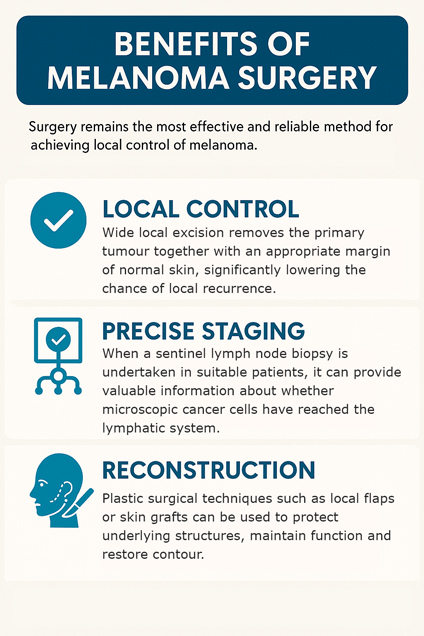
Surgery remains the most effective and reliable method for achieving local control of melanoma. Wide local excision removes the primary tumour together with an appropriate margin of normal skin, significantly lowering the chance of local recurrence. For most people with early-stage melanoma, this procedure alone is curative.
Another key benefit of surgery is the opportunity for precise staging. When a sentinel lymph node biopsy is undertaken in suitable patients, it can provide valuable information about whether microscopic cancer cells have reached the lymphatic system. The outcome of this test assists in guiding follow-up intensity and determining whether additional therapies are warranted.
Melanoma surgery also allows for reconstruction in areas where simple closure is not possible. Plastic surgical techniques such as local flaps or skin grafts can be used to protect underlying structures, maintain function and restore contour. These techniques are especially useful for lesions on the face, hands and feet, where tissue mobility and cosmetic considerations require careful balance. Each surgical plan is designed to address not only the cancer itself but also the long-term integrity of the skin and surrounding tissues.
As melanoma surgery is an oncologic procedure, public display of before-and-after photos is not typically appropriate. In Australia, clinical imagery for medical advertising is regulated under AHPRA guidelines. For educational purposes, Dr Mistry may show representative images privately during consultation to help explain potential reconstructive approaches and typical healing outcomes. These examples are strictly used to support informed consent and are never shared publicly without explicit patient permission.
Your initial consultation with Dr Mistry at the Charlestown Healthcare Hub provides an opportunity to discuss your diagnosis and treatment plan in detail. During this appointment, Dr Mistry will review your biopsy report, medical history and overall health. He will examine the affected area and assess the condition of the surrounding skin and lymph nodes. This physical evaluation helps determine the most suitable surgical approach and whether additional imaging or diagnostic studies are required before proceeding.
The consultation includes a clear explanation of surgical options. Dr Mistry will describe how wide local excision is performed and whether sentinel lymph node biopsy is recommended in your situation. If reconstruction is anticipated, he will outline the various techniques that may be used, such as primary closure, local flap rotation or skin grafting. The choice depends on the location, tissue laxity and expected size of the excision.
Recovery expectations, wound care and follow-up appointments are also discussed. You will receive written information explaining how to prepare for the procedure, what to expect on the day of surgery and how to care for the surgical site afterwards. This meeting allows time for questions and ensures you fully understand the planned procedure, the risks involved and the rationale for each decision.
Melanoma surgery is performed in hospital or an accredited day surgery environment under either local anaesthesia with sedation or general anaesthesia, depending on the size and location of the melanoma and whether sentinel lymph node biopsy is included. The operation begins with careful surgical marking of the biopsy site. The surrounding area is prepared to include an appropriate margin of normal tissue, determined by the tumour’s Breslow thickness and the national guidelines for melanoma excision.
The excision is then carried out as a single, full-thickness removal of the lesion and margin. The specimen is marked and sent to pathology to confirm clear margins and assess for any residual disease. In cases where the melanoma is thicker or presents with high-risk features, sentinel lymph node biopsy may be performed during the same procedure. This involves injecting a small amount of tracer dye near the original melanoma site to identify the first lymph node or nodes that drain the area. The identified nodes are then removed through a small incision and analysed by a pathologist.
Reconstruction follows the excision. For small defects, the wound may be closed directly. Larger or complex defects, particularly those in areas where skin is tight or movement is important, may require local flaps or skin grafts. A local flap uses nearby skin and tissue that retains its own blood supply to cover the defect, while a skin graft involves transferring skin from another area of the body. The choice depends on the size and location of the wound and the desired functional and aesthetic outcome.
Dressings are applied to protect the site, and you are monitored in recovery before returning home or staying overnight if indicated. The procedure’s duration varies from less than an hour for simple excisions to several hours for complex cases that include reconstruction and lymph node biopsy.
Recovery after melanoma surgery depends on the extent of the procedure, the location of the excision and your general health. In the first few days, it is normal to experience mild discomfort, swelling and bruising around the wound. Pain-relief medication and rest generally provide adequate comfort. Dressings are left intact for the first several days, and you will receive instructions on how to care for them at home.
Your first post-operative review usually takes place within one to two weeks. At this appointment, Dr Mistry will examine the wound, remove sutures if necessary, and review the final pathology results. If the pathology shows involved margins or unexpected findings, further treatment options will be discussed. In cases where a sentinel lymph node biopsy has been performed, results are reviewed once available, and onward referral to medical oncology may be arranged if required.
Most people are able to resume light activities within several days, although this depends on the site and complexity of the surgery. It is important to avoid stretching or excessive movement of the surgical site during early healing. Physical jobs or sports may require a longer recovery period to prevent wound stress. Scar management, including moisturising, silicone therapy and sun protection, is discussed once the wound has fully healed.
Long-term follow-up is essential after melanoma surgery. Regular skin checks are recommended to detect any new or recurrent lesions early. Follow-up intervals vary based on your stage of disease, pathology findings and personal risk factors. These visits may be shared between Dr Mistry, your GP and your dermatologist to ensure coordinated care.
All surgical procedures carry potential risks. With melanoma surgery, these risks include bleeding, infection, delayed healing, scarring and temporary changes in sensation near the incision or donor site. Occasionally, fluid accumulation or minor wound breakdown can occur, particularly in areas of tension or after sentinel lymph node biopsy. Although uncommon, lymphoedema may develop after lymph node procedures and can be managed with physiotherapy and compression techniques if identified early.
Reconstruction carries its own considerations, such as partial loss of a graft or flap, which may require additional wound care or, rarely, revision surgery. Anaesthetic complications, while uncommon, are discussed with your anaesthetist before the procedure. It is important to follow all post-operative care instructions, attend scheduled reviews and contact the clinic if any concerning symptoms develop.
The cost of melanoma surgery varies depending on several factors, including the complexity of the excision, whether sentinel lymph node biopsy or reconstruction is required, the hospital or day-surgery facility used, anaesthetic services, pathology costs and the length of follow-up care. After your initial consultation and a confirmed treatment plan, you will receive a personalised written estimate outlining the components of your procedure. Dr Mistry’s team provides transparent information to help you understand the expected costs, without listing dollar amounts online.
Because melanoma surgery is considered medically necessary, some components of your procedure may attract a Medicare rebate. If you have private health insurance, your fund may also contribute toward hospital and surgeon fees depending on your policy and level of cover. Eligibility is determined by Medicare and your insurer and can vary based on the specific procedure performed and your clinical situation. It is advisable to contact your health fund with your written estimate to confirm coverage and any applicable excess. Item numbers and relevant clinical descriptors are discussed in consultation once your plan is finalised.
Dr Yezdi Mistry is a fully qualified Specialist Plastic and Reconstructive Surgeon holding FRACS (Plastic Surgery) with registration number MED0001861566. He serves the broader Newcastle and Hunter community, having previously worked as a Visiting Medical Officer at John Hunter Hospital in both plastic and hand surgery. Dr Mistry founded his private practice, Dr Mistry Specialist Plastic Surgeon, at the Charlestown Healthcare Hub, where he provides personalised surgical care in a modern, accredited setting.
Dr Mistry’s commitment to ongoing education includes participation in advanced international surgical training programs. His professional memberships include the Royal Australasian College of Surgeons (RACS), the Australian Society of Plastic Surgeons (ASPS), the Australian Society of Aesthetic Plastic Surgeons (ASAPS), the American Society of Plastic Surgeons (ASPS) and the International Society of Aesthetic Plastic Surgeons (ISAPS). His focus is on precise surgical technique, open communication and evidence-based care. Every treatment plan is created in collaboration with the patient’s broader care team to ensure a coordinated and comprehensive approach to melanoma management.
If you would like to discuss melanoma surgery in Newcastle or obtain a professional opinion about treatment options, please contact:
Dr Mistry Specialist Plastic Surgeon
Charlestown Healthcare Hub
Suite 312, Level 3, 99 Pacific Highway
Charlestown NSW 2290
Phone: (02) 4062 7888
Email: admin@drmistry.com.au
Dr Mistry provides surgical care to patients from Charlestown, Newcastle, Lake Macquarie and the Hunter region, working collaboratively with existing healthcare providers to deliver thorough, coordinated treatment.
The main goal is to remove the melanoma along with a margin of healthy skin to ensure complete excision while maintaining function and form. In some cases, sentinel lymph node biopsy is also performed to assess for microscopic spread.
The margin size depends on the thickness of the melanoma as reported in the biopsy. Australian guidelines recommend specific margin widths for different tumour depths to balance effective cancer removal with optimal wound closure.
Not all patients require sentinel lymph node biopsy. It is generally recommended for melanomas with a Breslow thickness greater than or equal to 1.0 mm or for thinner lesions with high-risk features such as ulceration. The decision is made individually after careful evaluation.
Recovery times vary depending on the extent and location of surgery. Most patients return to light activities within a week or two, while full recovery and scar maturation may take several months.
There is always a possibility of recurrence or new primary melanomas forming. Regular skin checks and adherence to follow-up schedules are essential for early detection and management.
Warning signs include changes in an existing mole, new pigmented spots, irregular borders, colour variation, or a lesion that bleeds or itches. The ABCDE guide (Asymmetry, Border, Colour, Diameter, Evolving) can assist in identifying suspicious lesions.
frequency of follow-up depends on the stage of your melanoma and personal risk factors. Many patients are reviewed every 3 to 6 months initially, then annually once stable, with shared care between your GP and dermatologist.
Fill in your details and our friendly team will be in touch with you
Please Note: Information provided on Dr Mistry’s website is provided as a basic guide, it does not constitute a diagnosis and should not be taken as medical advice. Any surgical or invasive procedure carries risks.




“I care because it’s my job as a surgeon, as a plastic surgeon, to do the appropriate thing and to give you a good outcome. I want to leave knowing that I can tell a patient, hand on heart, that I did the very best I could and that I looked after them, so when I see them post op later that day or the next morning, that they feel they were in good hands.”
– Dr Yezdi Mistry
Request a Consult