
Skin tags and benign skin growths are common and often harmless, but some cause discomfort or uncertainty. Removal can provide relief and, when needed, confirm the diagnosis with pathology.

Skin tags and benign skin growths are extremely common findings in clinical practice and affect people of all ages. They can appear gradually over time and often develop in areas exposed to friction, pressure, or repeated movement. While many skin tags and benign growths are medically harmless and do not require treatment, some patients seek professional assessment due to physical discomfort, recurrent irritation, hygiene concerns, or uncertainty about the nature of the lesion.
Skin tag and skin growth removal in Newcastle, when performed by a qualified Specialist Plastic and Reconstructive Surgeon, focuses on accurate diagnosis, appropriate technique selection, and careful management of the surrounding skin. The goal is not simply removal, but supporting accurate identification of the lesion and undertaking treatment in a controlled and medically appropriate manner.
Dr Yezdi Mistry, Specialist Plastic and Reconstructive Surgeon based in Charlestown, NSW, approaches the assessment and management of skin tags and skin growths with a strong emphasis on patient safety and clinical accuracy. Every consultation begins with a detailed examination and discussion, allowing patients to understand the nature of their skin lesion and whether removal is suitable. This careful approach supports treatment decisions that are guided by medical best practice rather than appearance alone.
Skin tags, medically referred to as acrochordons, are small benign growths that commonly develop in areas where skin rubs against skin or clothing. They are often soft to the touch, flesh coloured or slightly darker, and connected to the skin by a narrow stalk. Skin tags can vary in size and may increase in number over time.
Common areas where skin tags occur include the neck, underarms, groin, eyelids, beneath the breasts, and along natural skin folds. Factors such as friction, hormonal changes, genetics, and certain medical conditions may influence their development, although the exact cause is not always clear.
In addition to skin tags, patients may present with a variety of other benign skin growths. These can include seborrhoeic keratoses, benign moles, cysts, lipomas, and other non-cancerous lesions. While many of these growths are harmless, some may resemble conditions that require further investigation.
Accurate identification of a skin lesion is a critical step before considering removal. Some lesions that appear benign at first glance may warrant monitoring, biopsy, or referral for further assessment. Dr Yezdi Mistry conducts a thorough clinical examination to differentiate between lesions that are suitable for removal in a clinical setting and those that require additional diagnostic steps. This careful assessment supports patients in receiving care tailored to their individual circumstances.
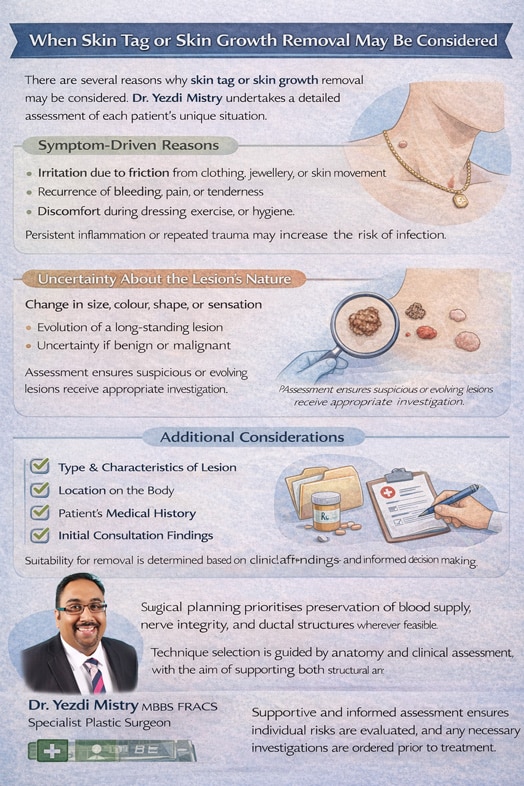
Skin tag or skin growth removal may be considered for a range of reasons, depending on the individual patient and the characteristics of the lesion. One of the most common reasons patients seek assessment is ongoing irritation. Lesions located in areas exposed to friction from clothing, jewellery, or skin movement can become inflamed, tender, or prone to bleeding.
Some patients experience discomfort during daily activities such as dressing, exercising, or personal hygiene. In certain cases, repeated trauma to a lesion may increase the risk of infection or delayed healing.
Another important reason for assessment is uncertainty about the nature of a skin growth. Any lesion that changes in size, colour, shape, or sensation should be examined by a qualified medical professional. Even lesions that have been present for many years can change over time. Dr Yezdi Mistry encourages patients in Charlestown and surrounding regions to seek professional review if they notice new growths or changes to existing lesions.
Suitability for removal depends on several factors, including the type of lesion, its location, size, and appearance, as well as the patient’s medical history and skin characteristics. Not all lesions are appropriate for removal during an initial consultation, and some may require further investigation before treatment is considered. This careful decision-making process supports patient safety and appropriate clinical care.
Patients seek removal of skin tags or skin growths for a variety of practical and medical reasons. Recurrent irritation is a common concern, particularly when lesions are located in high-friction areas. Repeated catching or rubbing can lead to soreness, bleeding, or inflammation that interferes with daily comfort.
Some patients request removal because a lesion interferes with routine activities such as shaving, dressing, or the use of medical or support devices. In these situations, removal may reduce ongoing inconvenience and the risk of repeated minor injury to the skin.
Another reason patients seek removal is to allow clearer monitoring of their skin. When multiple lesions are present, distinguishing between long-standing growths and new changes can be challenging. Removal of selected lesions may assist with future skin surveillance and provide reassurance following medical assessment.
Dr Yezdi Mistry takes time to understand each patient’s concerns and expectations. Decisions regarding removal are made collaboratively, with clear explanation of whether the lesion is suitable for treatment and what outcomes can realistically be expected. This patient-centred approach supports informed decision-making and appropriate care.
Clinical documentation is an important part of medical care, particularly when managing skin lesions. In some cases, clinical photographs may be taken before and after skin tag or skin growth removal. These images assist with accurate documentation, follow-up assessment, and continuity of care.
Clinical photography is only undertaken with the patient’s informed consent and is managed in accordance with privacy legislation and professional guidelines. Images form part of the confidential medical record and are stored securely.
Photography is used solely for clinical purposes and is not employed for advertising or promotional activities. Its role is to support accurate medical assessment and long-term patient care.
The method used to remove a skin tag or skin growth depends on the type of lesion, its size, location, and clinical features. Procedures are generally performed in a clinical environment using sterile technique. Local anaesthetic may be used when appropriate to reduce discomfort during the procedure.
Dr Yezdi Mistry selects the most suitable removal method based on careful assessment. Techniques may include surgical excision, cautery, or other medically accepted approaches. Each method is chosen to reduce trauma to the surrounding skin while allowing precise removal of the lesion.
For lesions that require further analysis, the removed tissue may be sent for histopathological examination at an accredited laboratory. This step is particularly important when there is any uncertainty regarding the diagnosis or when recommended based on clinical findings.
Throughout the procedure, patient comfort, communication, and safety remain the priority. Patients are informed about what to expect at each stage, and clear post-procedure instructions are provided to support optimal healing.
All medical procedures carry some degree of risk, and skin tag or skin growth removal is no exception. While complications are uncommon, potential risks include bleeding, infection, scarring, delayed wound healing, changes in skin sensation, or pigment alteration at the treatment site.
Certain areas of the body may be more prone to noticeable scarring or prolonged healing, particularly where skin tension is higher. Individual healing responses vary between patients, and outcomes cannot be guaranteed.
There is also a possibility that a skin tag or growth may recur, or that new lesions may develop elsewhere over time. Removal of one lesion does not prevent others from forming.
Dr Yezdi Mistry discusses potential risks and limitations in detail during consultation so that patients can make informed decisions. Careful technique and adherence to aftercare instructions reduce the likelihood of complications, but it is important that patients have realistic expectations regarding outcomes.
Recovery following skin tag or skin growth removal is usually straightforward, although this depends on the size, depth, and location of the lesion. Many patients are able to resume normal daily activities shortly after the procedure, with some temporary modifications to protect the treated area.
Aftercare instructions are provided and may include guidance on wound care, keeping the area clean and dry, and avoiding activities that could place strain on the healing skin. Mild redness, swelling, or tenderness can occur in the early stages of healing and typically settles as recovery progresses.
Patients are advised to monitor the treated area for signs of infection or delayed healing and to contact the clinic if they have concerns. Follow-up appointments may be recommended to assess healing or to discuss pathology results if tissue has been sent for analysis.
Removal of a skin tag or skin growth does not eliminate the possibility of future lesions developing. Ongoing skin monitoring is an important aspect of long-term care, particularly for patients with multiple lesions or a history of skin changes.
Patients are encouraged to remain attentive to their skin and to seek medical review if new growths appear or if existing lesions change in appearance, size, or sensation. Regular assessment by a qualified medical professional supports early identification of concerns and appropriate management.
Dr Yezdi Mistry emphasises the importance of informed skin awareness and encourages patients to raise any questions or concerns during follow-up consultations.
The cost of skin tag or skin growth removal varies depending on several factors. These include the number of lesions being treated, their size and location, the complexity of the procedure, and whether histopathological examination is required.
Professional fees are discussed transparently during consultation so that patients have a clear understanding of what is involved before proceeding. This allows patients to make informed decisions about their care without pressure.
Dr Yezdi Mistry’s Charlestown practice provides fee information in line with medical standards and encourages open discussion regarding any questions patients may have about the treatment process.
In some cases, assessment and removal may occur during the same appointment if the lesion is clearly benign and suitable for treatment. This depends on clinical findings, location, and whether further investigation is required.
Not all lesions require histopathological examination. Tissue may be sent for analysis if there is any diagnostic uncertainty or if clinical findings indicate that further assessment is appropriate.
A treated lesion does not usually return once fully removed. However, new skin tags or growths can develop over time in other areas of the body.
Yes. Lesions in areas such as the eyelids, groin, or other sensitive regions require particular care and may influence the choice of technique and aftercare advice.
Long-standing lesions may still be assessed if they cause irritation or concern. Stability over time can be reassuring, but clinical examination remains important.
Certain medications or health conditions can influence healing or bleeding risk. These factors are reviewed during consultation to guide appropriate planning.
Care is taken to limit impact on nearby tissue. Healing responses vary, and this is discussed during assessment so expectations are clear.
The approach may differ depending on number, size, and distribution. Management is individualised based on overall assessment rather than a one-size approach.
Skin type is considered during planning, as healing and pigment response can vary. This is discussed as part of informed consent.
Patients are advised to seek review if they notice unexpected changes during healing or have concerns about the treated area. Follow-up may also be recommended depending on pathology findings or clinical factors.
Preparation for a skin tag or skin growth assessment is generally simple. Patients are usually advised to avoid applying creams, lotions, or makeup to the area being assessed on the day of the appointment.
Bringing information about relevant medical history, current medications, and any previous treatment to the area can assist with accurate assessment. Patients should also mention any history of bleeding disorders, skin conditions, or concerns about wound healing.
Dr Yezdi Mistry conducts a thorough medical history and examination to support careful planning of any proposed procedure and alignment with the patient’s overall health.
Patients attending the Charlestown clinic can expect a professional and respectful environment where their concerns are addressed with care, clarity, and clinical expertise.
Choosing to have skin tag or skin growth removal performed by a Specialist Plastic and Reconstructive Surgeon offers the benefit of advanced anatomical knowledge, precise surgical technique, and comprehensive clinical assessment. These factors are particularly important when lesions are located in visible or sensitive areas.
Dr Yezdi Mistry brings specialist training, clinical experience, and an in-depth understanding to the assessment and management of skin lesions. His approach prioritises patient understanding, safety, and evidence-based care at every stage.
Located in Charlestown, NSW, Dr Yezdi Mistry’s practice provides professional assessment and management of skin tags and benign skin growths for patients across Newcastle and surrounding regions. Each consultation is guided by clinical integrity, clear communication, and respect for individual patient needs.
Fill in your details and our friendly team will be in touch with you
Please Note: Information provided on Dr Mistry’s website is provided as a basic guide, it does not constitute a diagnosis and should not be taken as medical advice. Any surgical or invasive procedure carries risks.

“I care because it’s my job as a surgeon, as a plastic surgeon, to do the appropriate thing and to give you a good outcome. I want to leave knowing that I can tell a patient, hand on heart, that I did the very best I could and that I looked after them, so when I see them post op later that day or the next morning, that they feel they were in good hands.”
– Dr Yezdi Mistry
Request a Consult