At Dr Mistry Specialist Plastic Surgeon in Charlestown, Dr Yezdi Mistry (BHB, MBChB, FRACS Plastic Surgery; Registration No. MED0001861566) offers comprehensive care for individuals requiring surgical management of squamous cell carcinoma (SCC). Serving patients across Newcastle, Lake Macquarie and the Hunter region, the practice is focused on delivering evidence-based, carefully planned treatments designed to achieve effective cancer removal while maintaining the function and integrity of the affected area.
Squamous cell carcinoma surgery is considered primarily reconstructive and functional. The core aim is to achieve full removal of the tumour with clear surgical margins appropriate to its risk level. Following this, reconstruction may be necessary to support the skin’s natural barrier and maintain form and movement, particularly when lesions are located in areas such as the face, scalp, lips, or hands. In visible areas, surgical repair is also planned with attention to aesthetic balance and skin texture, while always prioritising the complete clearance of cancer.
Download Dr Mistry’s Skin Cancer Removal Guide
×
Get Your Ultimate Skin Cancer Removal Guide
What Is Squamous Cell Carcinoma?
Squamous cell carcinoma is a type of skin cancer that originates in the keratinocyte cells of the epidermis. It is often associated with cumulative ultraviolet (UV) exposure from the sun over many years and is one of the most frequently diagnosed skin cancers in Australia. SCC can appear as a firm, scaly patch, an ulcer that fails to heal, or a raised, sometimes tender lesion. While many SCCs grow slowly and remain localised, some can behave more aggressively, invading deeper tissues or spreading to lymph nodes if not treated promptly.
Treatment for SCC focuses on complete excision with adequate margins to ensure that no malignant cells remain. Histopathology confirms whether the margins are clear and assesses features such as tumour depth, differentiation, and whether there is nerve or vascular involvement. Each case is assessed individually, taking into account the patient’s overall health, immune status, and tumour characteristics, to determine the best course of action. When required, reconstruction is undertaken to preserve movement and minimise functional impairment, ensuring the surrounding tissues are supported and the wound heals effectively.
Who May Consider Surgical Treatment
Surgical treatment is suitable for individuals who have been diagnosed with SCC through biopsy and require definitive excision. Patients are often referred for specialist management when the cancer is located in areas where precise reconstruction is necessary, such as around the eyes, nose, ears, lips, or scalp. People with tumours that display high-risk features – such as deep invasion, rapid growth, or perineural involvement – also benefit from management by a Specialist Plastic and Reconstructive Surgeon. Those with suppressed immune systems or who have experienced multiple skin cancers may require a coordinated approach with dermatology or oncology.
A consultation with Dr Mistry includes a detailed review of the tumour’s characteristics and a discussion of available treatment options. This allows patients to understand the rationale for surgery, what to expect from reconstruction, and how follow-up care will be structured. Decisions are made collaboratively, with the patient’s safety, recovery, and comfort at the forefront.
Benefits of Surgical Management
Surgery remains the mainstay of treatment for most cutaneous squamous cell carcinomas. The procedure provides both diagnostic and therapeutic advantages. By removing the cancer completely, surgery ensures that tissue samples can be examined under a microscope to verify clearance and assess the cancer’s behaviour. This information is essential in guiding ongoing surveillance and determining whether any additional treatment is needed.
Reconstruction following excision aims to preserve function in delicate or high-mobility regions. For instance, maintaining eyelid closure, lip competence, nasal airflow, and ear or hand contour is crucial to daily activities and comfort. In addition, careful planning of incisions along natural skin lines supports optimal healing. Each surgery is carefully designed to ensure the most effective removal of cancer while respecting the natural movement and structure of the area involved.
Before and After Photos (For Aesthetic Procedures Only)
As surgical treatment for SCC is medically indicated rather than aesthetic in purpose, before-and-after photos are not routinely displayed online. However, patients may review educational examples during their consultation to understand possible reconstructive outcomes. These images serve as learning tools and are not intended to predict or guarantee individual results. All visual material is handled in accordance with AHPRA advertising standards.
Consultation for Squamous Cell Carcinoma With Dr Yezdi Mistry
A consultation at Dr Mistry Specialist Plastic Surgeon in Charlestown is structured to provide a clear understanding of the diagnosis, procedural plan, and recovery expectations. During this appointment, Dr Mistry reviews the patient’s full medical history, including prior skin cancers, sun exposure, and any medications that may influence healing, such as anticoagulants or immune-modulating drugs. A thorough clinical assessment follows, during which the lesion is examined, and where necessary, adjacent lymph nodes are palpated to assess for spread.
If a biopsy has not yet been performed, it can be arranged to confirm the diagnosis before proceeding with surgery. Imaging studies such as ultrasound or CT may be recommended for high-risk tumours to assess their depth or proximity to vital structures. Once the full clinical picture is established, Dr Mistry discusses the surgical options, including the type of excision required, anaesthetic considerations, and potential reconstructive techniques.
Patients are encouraged to ask questions and review their options carefully before booking surgery. Instructions are provided for preparation, including fasting guidelines, medication adjustments if applicable, and what to expect on the day of the procedure. By taking time to plan and discuss the operation, patients can approach their surgery with clarity and realistic expectations.
How Squamous Cell Carcinoma Surgery Is Performed
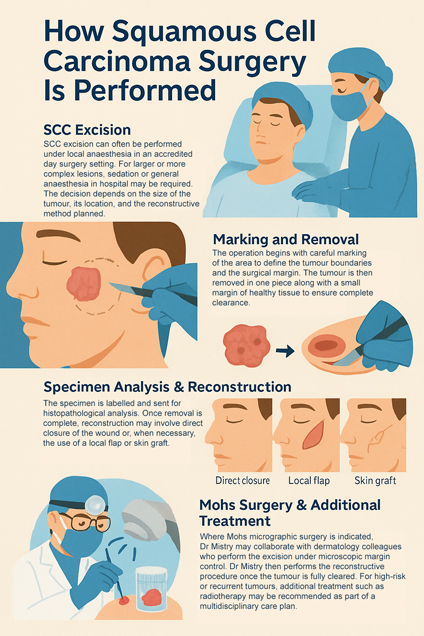
SCC excision can often be performed under local anaesthesia in an accredited day surgery setting. For larger or more complex lesions, sedation or general anaesthesia in hospital may be required. The decision depends on the size of the tumour, its location, and the reconstructive method planned.
The operation begins with careful marking of the area to define the tumour boundaries and the surgical margin. The tumour is then removed in one piece along with a small margin of healthy tissue to ensure complete clearance. The specimen is labelled and sent for histopathological analysis. Once removal is complete, reconstruction may involve direct closure of the wound or, when necessary, the use of a local flap or skin graft. In situations where significant tissue has been removed, a staged reconstruction may be required to achieve the best functional outcome.
Where Mohs micrographic surgery is indicated, Dr Mistry may collaborate with dermatology colleagues who perform the excision under microscopic margin control. Dr Mistry then performs the reconstructive procedure once the tumour is fully cleared. For high-risk or recurrent tumours, additional treatment such as radiotherapy may be recommended as part of a multidisciplinary care plan.
Recovery After Surgery
After the operation, patients are monitored while the anaesthetic wears off. Dressings are applied to protect the surgical site and maintain stability, particularly if grafts or flaps have been used. Mild swelling, bruising, or tightness are expected during the first week. Pain is generally managed with simple medication, and patients receive written aftercare instructions.
Dressings should be kept dry unless advised otherwise. Gentle elevation of the treated area, such as propping the head on extra pillows for facial surgery or raising the leg for lower limb procedures, helps minimise swelling. Activity is usually limited to light movements for the first few days, gradually resuming normal tasks as directed. Stitches are generally removed between five and fourteen days post-surgery, depending on the site and the type of closure.
Long-term recovery focuses on scar maturation and skin care. Scars typically evolve over several months, becoming lighter and softer with time. Sun protection remains essential throughout the healing process, as ultraviolet exposure can affect scar appearance and increase the risk of further skin damage. Regular follow-up appointments allow for wound assessment, discussion of pathology results, and monitoring for recurrence.
Risks and Possible Complications of SCC Surgery
Every surgical procedure carries some risk, and these are discussed in detail during the consent process. The most common issues following SCC excision include bleeding, infection, or delayed wound healing. Depending on the complexity of reconstruction, there may also be a risk of partial graft or flap loss. Altered sensation or temporary numbness around the incision can occur, particularly in areas where fine nerves are involved. Some patients experience thickened or raised scars, which may require further management.
In a small number of cases, recurrence of the cancer at the site or spread to lymph nodes can occur, particularly in tumours with high-risk features. Dr Mistry discusses individual risk factors during consultation and outlines how follow-up care will monitor for these possibilities. Anaesthetic risks, while uncommon, are also explained to ensure that each patient fully understands their procedure and the associated considerations.
Cost of Squamous Cell Carcinoma Surgery
The cost of treatment varies based on the size and location of the tumour, the complexity of the excision, and the reconstructive technique required. Other factors include the type of anaesthesia, hospital or day-surgery facility fees, pathology costs, and follow-up appointments. Because each case is different, patients receive a personalised estimate following consultation.
Detailed information about inclusions and billing practices is available on the clinic’s Fees & Costs page. No specific prices are published, in accordance with AHPRA guidelines, but the practice team can assist in explaining what factors contribute to the total cost and what is included in the quote.
Medicare Coverage and Private Health Insurance
Surgical management of biopsy-confirmed squamous cell carcinoma may attract Medicare item numbers and, in some cases, private health insurance rebates. Eligibility depends on the medical indication, the type of procedure, and the patient’s insurance policy. The administrative team can assist with documentation to facilitate claims and clarify procedural codes where applicable. Patients are encouraged to check their own coverage with their insurer, as entitlements differ between providers and policies.
Why Choose Dr Yezdi Mistry
Dr Yezdi Mistry is a Specialist Plastic and Reconstructive Surgeon (FRACS Plastic Surgery) with years of experience in managing skin cancers and performing complex reconstructions. In addition to his private practice at the Charlestown Healthcare Hub, he serves as a Visiting Medical Officer at John Hunter Hospital, contributing to the surgical care of patients throughout the region. His practice philosophy centres on precise, patient-focused treatment supported by up-to-date surgical knowledge and multidisciplinary collaboration.
Dr Mistry has undertaken advanced training, including international education at the Body Contouring Academy in Paris, and continues to expand his expertise through ongoing professional development. His approach combines technical precision with a thoughtful, measured plan for each patient’s unique needs. The practice works closely with dermatologists, oncologists, and radiation specialists to ensure coordinated, comprehensive care.
Book An Appointment
If you have been diagnosed with squamous cell carcinoma or have a concerning lesion that requires evaluation, you can arrange a consultation with Dr Yezdi Mistry for a thorough assessment and discussion of treatment options.
Squamous cell carcinoma is primarily caused by long-term exposure to ultraviolet (UV) radiation from the sun or artificial sources such as tanning beds. It can also develop in scars, chronic wounds, or areas of previous inflammation. Protecting the skin from UV exposure significantly reduces risk.
How is squamous cell carcinoma diagnosed?
Diagnosis is confirmed by a biopsy, where a small sample of the lesion is examined under a microscope. This determines whether cancer cells are present and provides information about tumour type, depth, and differentiation.
What is the main treatment for squamous cell carcinoma?
Surgical excision remains the most common and effective treatment for SCC. It allows for complete removal of the cancer and provides tissue for microscopic analysis to confirm that margins are clear.
How long does recovery take after surgery?
Most patients recover within a few weeks, depending on the size and location of the surgery. Swelling and mild discomfort are common initially, and scars gradually improve over several months with appropriate care.
Can squamous cell carcinoma come back?
While many SCCs are completely removed during surgery, there is a small chance of recurrence, particularly for tumours with high-risk features. Regular follow-up appointments and skin checks are essential for early detection of any recurrence or new lesions.
Is squamous cell carcinoma life-threatening?
Most SCCs are treatable when identified early. However, some aggressive forms can spread to nearby lymph nodes or distant organs. Early diagnosis and treatment by a qualified specialist are key to achieving the best possible outcome.
How can I reduce my risk of developing more skin cancers?
Practising sun protection every day—using SPF 50+ sunscreen, wearing protective clothing, seeking shade, and avoiding tanning beds—can help lower risk. Regular skin checks by your GP or dermatologist also support early detection of new or changing lesions.
Fill in your details and our friendly team will be in touch with you
Please Note: Information provided on Dr Mistry’s website is provided as a basic guide, it does not constitute a diagnosis and should not be taken as medical advice. Any surgical or invasive procedure carries risks.
A Newcastle Surgeon That Cares
“I care because it’s my job as a surgeon, as a plastic surgeon, to do the appropriate thing and to give you a good outcome. I want to leave knowing that I can tell a patient, hand on heart, that I did the very best I could and that I looked after them, so when I see them post op later that day or the next morning, that they feel they were in good hands.”