Adults across Newcastle, often seek information about surgical procedures that may help address changes in body shape that arise from weight variation, pregnancy or natural ageing. For individuals with more moderate changes in tissue firmness, energy-assisted surgical devices used with liposuction may be discussed as part of a broader treatment plan. Two devices that are frequently mentioned are Renuvion and BodyTite. These technologies deliver controlled energy beneath the skin during invasive procedures performed by trained surgeons.
At his Charlestown practice, Specialist Plastic and Reconstructive Surgeon Dr Yezdi Mistry provides assessments for adults who are considering surgery to address areas of concern related to body shape or localised fullness. Many individuals arrive with questions about how Renuvion and BodyTite differ, whether either device may suit their anatomy and how these technologies fit within established surgical options. This article outlines the mechanisms of each device, summarises current evidence and explains their potential role in selected patients.
Understanding Renuvion and BodyTite
Renuvion and BodyTite are medical devices used during invasive procedures. They are introduced beneath the skin through small incisions and applied by surgeons who have completed structured training in their use. These devices are not standalone cosmetic treatments. They may be used together with liposuction to deliver controlled thermal energy to connective tissues.
The purpose of this energy is to influence collagen structure and potentially encourage firmer tissue characteristics in suitable candidates. These devices do not replace excisional surgery. When a person has a substantial amount of redundant skin, removal of tissue remains the approach that offers predictable structural change. Energy-assisted devices may be considered only when the connective tissue demonstrates adequate elasticity and when changes are expected to respond to thermal treatment.
How Renuvion Works
Helium Plasma and Radiofrequency Energy
Renuvion produces a focused plasma stream created through the combination of helium gas and radiofrequency energy. When positioned beneath the skin, this plasma delivers rapid and highly concentrated heating. The helium disperses quickly, producing an immediate cooling effect. This process is designed to adjust collagen fibres and stimulate a controlled healing response.
In practice, Renuvion is usually introduced after liposuction. Using the same incisions, the surgeon moves the device beneath the skin in a controlled manner. Precision, training and attention to depth are essential because the heating produced by Renuvion is highly localised.
Renuvion handpieces are manufactured for use in different anatomical regions. Regulatory authorities continue to update specific indications, meaning surgeons must maintain awareness of current guidelines and recommended clinical pathways. Renuvion’s focused energy profile can be helpful in areas where targeted energy delivery is appropriate.
How BodyTite Works
✓ Bipolar Radiofrequency Energy
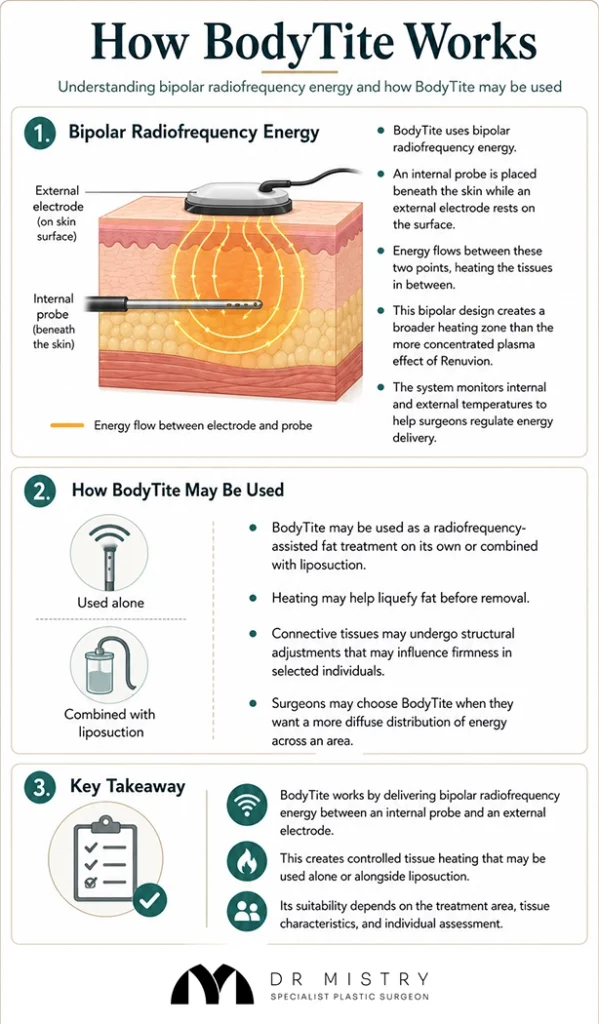
BodyTite belongs to a platform of devices that use bipolar radiofrequency energy. During treatment, an internal probe is placed beneath the skin and an external electrode rests on the surface. Energy flows between these two points, heating the tissues that lie between them.
This bipolar design produces a broader zone of heating compared with the concentrated plasma effect of Renuvion. The BodyTite system continuously monitors internal and external temperatures, providing feedback that assists surgeons in regulating energy delivery.
BodyTite may be used alone as a method of radiofrequency-assisted fat treatment or combined with liposuction. Heating may allow fat to liquefy before removal, while connective tissues may undergo structural adjustments that influence firmness in selected individuals. Surgeons may select BodyTite when they seek a more diffuse distribution of energy across an area.
Where These Devices May Be Applied
Adults aged 20 to 70 who attend consultations in Charlestown often present with concerns about the abdomen, flanks, thighs, arms, back or neck. The suitability of Renuvion or BodyTite depends on tissue thickness, elasticity, overall anatomy and personal health factors.
In the abdomen and flanks, these technologies may be discussed when there is moderate soft tissue looseness but not the level of redundancy that typically requires excisional surgery. Changes related to pregnancy or weight variation may influence eligibility, although each case requires careful assessment. When abdominal muscle separation or more extensive looseness is present, a procedure that removes excess skin may be more appropriate.
Arms and thighs vary greatly between individuals. Some adults have connective tissues that may respond to thermal treatment. Others may have more pronounced laxity for which an excisional approach is considered a more predictable option.
For the neck and under-chin region, energy-assisted devices may be considered when the tissues have suitable elasticity and when localised fullness plays a role in the overall appearance. When the neck demonstrates more substantial structural changes, a lifting procedure may provide more reliable adjustment.
Evidence Supporting Renuvion
Current research on Renuvion consists mainly of retrospective studies and case series. These studies offer practical insight into technique and tissue response but are not designed to establish definitive comparisons with other treatments.
One retrospective study following more than one hundred patients who underwent liposuction with Renuvion reported measurable adjustments in tissue firmness in selected individuals. The authors highlighted that outcomes were strongly connected to surgeon experience, appropriate patient selection and controlled application of energy.
Another study compared complication patterns between helium plasma devices and bipolar radiofrequency devices. Differences were observed, although the researchers noted that these findings were limited by the retrospective design, small sample size and involvement of a single centre.
Overall, available evidence suggests that Renuvion may contribute to firmer tissue characteristics in suitable candidates. The long-term data are still developing, and outcomes vary between individuals.
Evidence Supporting BodyTite
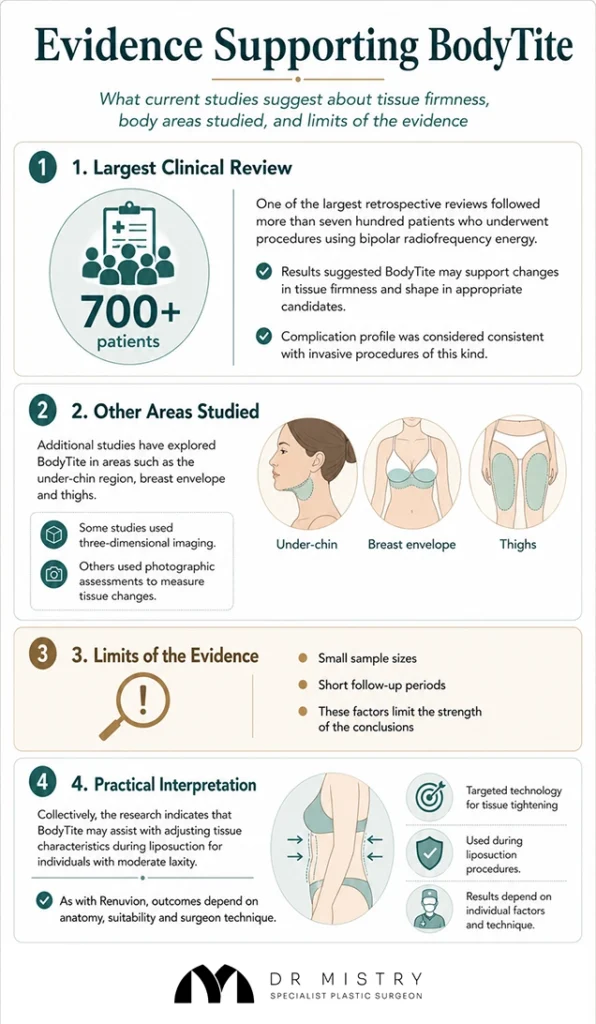
BodyTite has also been evaluated in several clinical studies. One of the largest retrospective reviews followed more than seven hundred patients who underwent procedures using bipolar radiofrequency energy. The results suggested that BodyTite may support changes in tissue firmness and shape in appropriate candidates, with a complication profile considered consistent with invasive procedures of this kind.
Additional studies have explored BodyTite in areas such as the under-chin region, breast envelope and thighs. Some utilised three-dimensional imaging or photographic assessments to measure tissue changes. Although improvements were noted in several of these studies, their small sample sizes and short follow-up periods limit the strength of the conclusions.
Collectively, the research indicates that BodyTite may assist with adjusting tissue characteristics during liposuction for individuals with moderate laxity. As with Renuvion, outcomes depend on anatomy, suitability and surgeon technique.
Explaining the Differences Without Promotional Language
AHPRA guidelines require that any comparison between medical devices remain factual, balanced and free of claims suggesting superiority. Based on available evidence and device characteristics, Renuvion and BodyTite differ primarily in energy delivery.
Renuvion uses a plasma-based system that provides rapid and concentrated heating. BodyTite uses bipolar radiofrequency energy that produces a broader distribution of heat. These differences affect how surgeons apply the device and how energy interacts with tissues.
Some surgeons may choose Renuvion when a focused application is preferred. Others may select BodyTite when a more diffuse pattern of energy delivery is useful. These decisions reflect surgeon training, in-depth understanding of device behaviour and individual patient anatomy, rather than any hierarchy between the devices.
Risks and Limitations
All invasive procedures carry risks. When energy-assisted devices are used with liposuction, potential risks include bleeding, swelling, bruising, temporary or ongoing changes in sensation, seroma formation, thermal injury, infection and scarring. When large areas are treated or when procedures are combined, rare but serious complications such as deep vein thrombosis, fat embolism or visceral injury may occur.
Renuvion has been the subject of international safety statements that emphasise the need to follow approved indications, device labelling and structured training. These communications reinforce the importance of controlled technique.
BodyTite has its own safety considerations. Research has noted that heating must be carefully regulated to avoid irregularities or prolonged swelling.
Risk varies between individuals and depends on overall health, surgical planning and the response of the tissues to treatment. During consultations, Dr Mistry supports individuals by explaining these risks in detail and placing them within the context of their personal health situation.
Why Energy-Based Devices Do Not Replace Excisional Surgery
Thermal energy cannot reverse the mechanical stretching of tissues that occurs with more pronounced redundancy. When the elasticity of the skin and underlying structures is reduced, removal of excess tissue offers the most predictable outcome.
Procedures such as abdominoplasty, arm reduction or thigh reduction physically remove redundant skin and reposition remaining tissues to create a more proportionate shape. These procedures involve incisions and a recovery period, but they offer structural adjustments that energy-based devices cannot achieve.
Energy-assisted devices may complement excisional surgery in selected cases, although they cannot substitute for tissue removal when significant redundancy is present.
Recovery Following Liposuction with Energy-Based Devices
Recovery after liposuction with Renuvion or BodyTite varies depending on general health, the number of areas treated and the procedure performed. Swelling is expected in the early recovery phase and gradually reduces over time. Bruising may be present for one to two weeks. Compression garments may be recommended to support tissue healing.
Most individuals return to routine activities within one to two weeks, although this varies according to occupation and the extent of surgery. Areas treated with energy-assisted devices may feel firm or tender initially, and these sensations usually progress as the tissues settle.
Longer term healing continues for several months. Follow-up appointments allow the surgeon to monitor progress, address concerns and provide guidance during the recovery period. Maintaining stable weight and healthy habits may support the durability of surgical outcomes.
Renuvion vs BodyTite FAQs
Can Renuvion or BodyTite be used without liposuction?
These devices are generally applied as part of an invasive procedure that includes liposuction because the tissues behave differently when both techniques are combined. In some selected situations, small areas may be treated without significant aspiration, although this depends entirely on anatomy and the surgeon’s assessment.
Do Renuvion and BodyTite feel different during recovery?
Most individuals describe the early healing period as similar to standard liposuction, although firmness or tightness can vary depending on the energy device used. Recovery experiences differ between individuals, so follow-up review helps monitor progress.
Can these devices change the texture of the skin surface?
Renuvion and BodyTite are applied beneath the skin, not on the surface, so their effect is directed at the deeper tissues. Any changes in skin texture tend to reflect the way the underlying tissues adjust during healing rather than a direct surface treatment.
Are these devices suitable for people who have previously lost a large amount of weight?
Some individuals who have experienced significant weight variation may have connective tissues that respond less predictably to thermal treatment. A surgeon evaluates whether the tissues have retained enough elasticity for these technologies or whether excisional surgery offers a more reliable option.
Is there an age limit for Renuvion or BodyTite?
There is no strict age limit, although tissue elasticity, medical history and overall health play a greater role in determining suitability. Older adults may still be considered if their tissues demonstrate adequate structural characteristics.
Can Renuvion or BodyTite be used in combination with excisional procedures?
In certain cases, these devices may be used to support adjustments in nearby regions when an excisional procedure is already being performed. The decision is based on anatomy and the surgeon’s judgment rather than routine combination.
Do the results from either device change over time?
Thermal treatment may continue to influence tissues for several months as healing progresses. Long-term changes depend on individual tissue behaviour, lifestyle factors and weight stability.
Are these devices appropriate for individuals with medical implants or previous surgical scars?
Suitability depends on the location and depth of the implant or scar, as well as the planned surgical pathway. A surgeon evaluates these factors carefully to determine whether energy-assisted treatment is appropriate.
Can these technologies be used on very small, localised areas?
Both devices can be applied to small regions, but the decision depends on tissue thickness, regional anatomy and the desired degree of adjustment. The surgeon assesses whether the device’s energy profile aligns with the characteristics of the targeted area.
How soon after the procedure can someone return to physical activity?
Most individuals resume gentle daily movement within the first week, although more strenuous activity is delayed to allow tissues to settle. The surgeon provides guidance tailored to the individual’s healing pattern and the extent of treatment.
Medical References
- Hoyos, A. E., Perez, M. E., Cala, L. C., Dominguez, R., Vranis, N. M., & Dayan, E. (2025). Helium plasma-driven radiofrequency for soft tissue adjustment: Clinical use and safety recommendations in high-definition body reshaping surgery. Aesthetic Surgery Journal Open Forum. https://doi.org/10.1093/asjof/ojae118
- Ruff, P. G. IV, Bharti, G., Hunstad, J., Kortesis, B., DiBernardo, B., Gentile, R., Cohen, S. M., & Shridharani, S. M. (2023). Safety and effectiveness of Renuvion helium plasma for subdermal tissue adjustment in the neck and submental region. Aesthetic Surgery Journal, 43(10), 1174-1188. https://doi.org/10.1093/asj/sjad055
- Divaris, M., Boisnic, S., Branchet, M., & Paul, M. D. (2011). A clinical and histological study of radiofrequency-assisted liposuction (RFAL) mediated tissue tightening and cellulite. Journal of Cosmetics, Dermatological Sciences and Applications, 1(2), 36-42.http://www.scirp.org/journal/paperinformation?paperid=5314
Are you Ready for Plastic Surgery? Take Our Quiz
How Dr Yezdi Mistry Applies These Technologies in Charlestown
Dr Yezdi Mistry has extensive training in body reshaping surgery and energy-assisted techniques and provides care to adults across the Hunter region. His approach emphasises detailed assessment, thorough planning and a clear explanation of benefits and limitations.
In his practice, Renuvion and BodyTite are considered tools that may assist in specific circumstances. They are not default treatments. Dr Mistry evaluates each individual’s anatomy, goals and medical background before determining whether these devices may contribute to their procedure. His recommendations reflect his clinical experience, focused training and understanding of tissue behaviour.
For some individuals, energy-assisted methods may offer support in adjusting tissue firmness and redistributing fat. For others, traditional excisional surgery may offer more predictable results. Dr Mistry encourages open discussion and provides guidance tailored to each person’s situation.
Key Insights for Adults Considering Renuvion or BodyTite in the Hunter Region
Renuvion and BodyTite are energy-based surgical devices that may support tissue adjustment during liposuction for selected individuals. They operate through different mechanisms but share the purpose of delivering thermal energy beneath the skin in a controlled manner.
Current research suggests that both devices can contribute to changes in tissue firmness in individuals with suitable anatomy. However, they do not replace excisional surgery when there is substantial redundant tissue.
Adults in Newcastle who are considering these technologies can benefit from a consultation with a FRACS-qualified Specialist Plastic Surgeon. Dr Mistry provides balanced, evidence-informed guidance to help individuals understand the potential benefits, limitations and risks of each approach.
Download Dr Mistry’s Cost of Surgery Guide

Further Reading
- Read more about Post Weight Loss Surgery
- Read more about Vaser Liposuction
- Read more about Body Lift (Upper & Lower)
- Read more about Fleur De Lis Abdominoplasty
- Read Dr Mistry’s Blog on Renuvion: Advanced Technology for Precision in Body Contouring
- Read Dr Mistry’s Blog on What is High Def Lipo and How Does it Work?