
Scar Management Resource Centre
Dr Mistry Plastic Surgery
Specialist plastic and reconstructive surgery with a focus on careful planning, evidence-based care, and comprehensive patient support.

Specialist plastic and reconstructive surgery with a focus on careful planning, evidence-based care, and comprehensive patient support.
Scarring is a natural part of the body’s healing process following surgery, injury, or skin trauma. Every incision heals by forming scar tissue, but the appearance, texture, and long-term quality of a scar can vary significantly between individuals.
Many factors influence scar development, including:
While no treatment can completely eliminate a scar, modern scar management strategies can help optimise healing and improve scar appearance.
Most scars continue to mature and remodel for 12–18 months following surgery.
Immediately following surgery, the body initiates a complex healing response.
During this period:
It is normal for scars to appear:
Collagen production increases rapidly and wounds gain strength.
Once the incision has fully healed and your surgeon confirms it is safe:
The body reorganises collagen fibres and begins refining scar tissue.
Scars may remain:
This is completely normal.
Scars gradually become:
Final scar appearance cannot usually be assessed before 12 months.
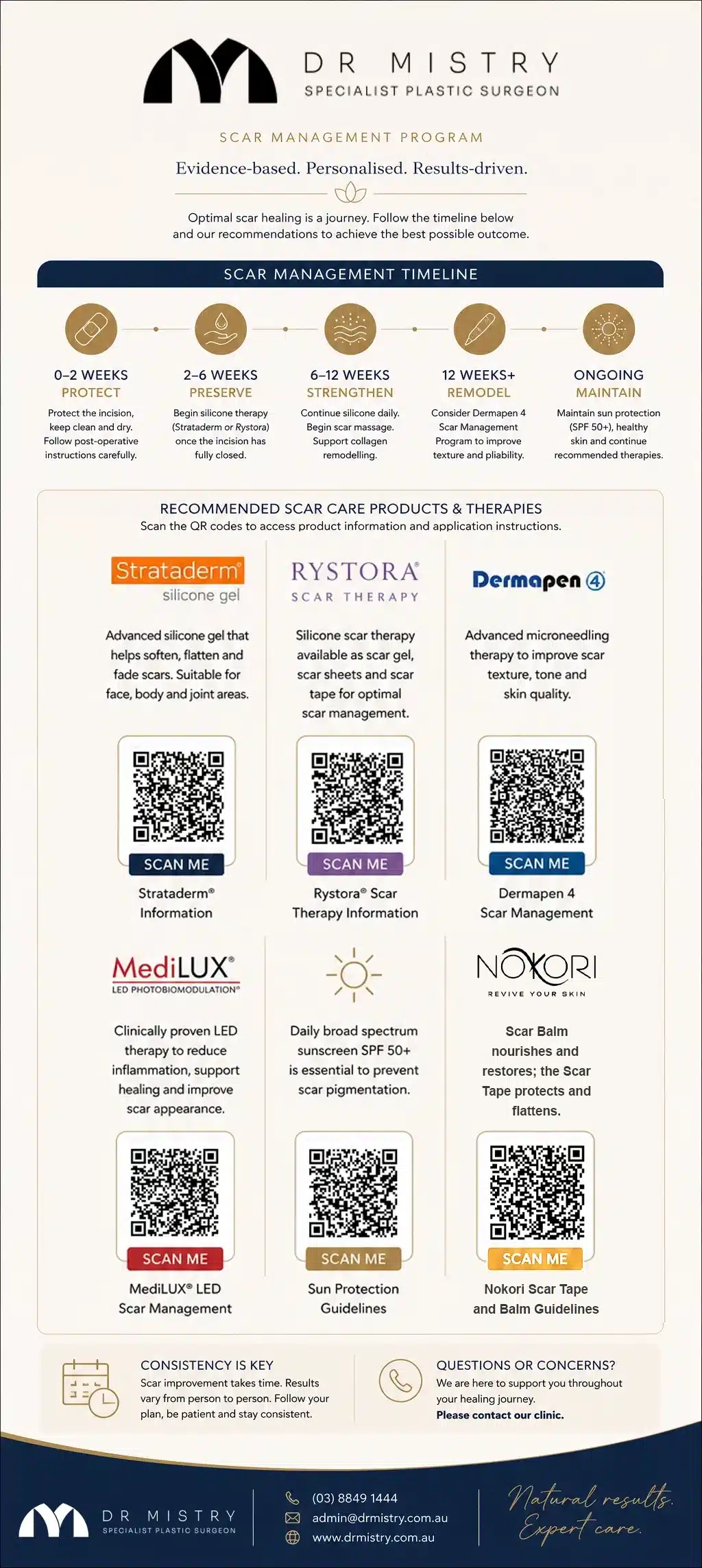
Silicone remains the most widely recommended first-line treatment for prevention and management of hypertrophic and problematic scars.
Silicone helps:
Silicone gel suitable for:
Available as:
May be useful for larger body scars and areas requiring prolonged coverage.
Generally:
This is usually between 2–4 weeks following surgery.
Most studies recommend:
Scar massage may be introduced once healing is sufficiently advanced and approved by your surgeon.
Potential Benefits
Typical Technique
Typically performed:
Only commence scar massage when advised by your treating surgeon.
Sun exposure is one of the most common causes of prolonged scar redness and pigmentation.
Fresh scars are particularly vulnerable to ultraviolet damage.
Protect scars from sun exposure for at least 12 months following surgery.
Photobiomodulation (PBM) uses specific wavelengths of light to stimulate cellular activity and support healing.
Unlike lasers, PBM does not create thermal damage or remove skin.
Studies suggest photobiomodulation may:
At Dr Mistry Plastic Surgery, MediLUX LED therapy may be recommended as part of a comprehensive recovery and scar management program.
Common therapeutic wavelengths include:
Associated with:
Associated with:
May vary according to procedure and individual healing.
Examples include:
Dermapen 4 is a medical microneedling device used to stimulate the body’s natural wound healing response.
Microneedling creates controlled micro-channels within the skin, encouraging:
Dermapen may assist with:
Timing depends on:
Many surgical scars are assessed for treatment from approximately 12 weeks onwards, although this may vary.
Many patients require:
More complex scars may require:
Treatment plans are individualised.
Dermapen 4 may be combined with:
to optimise outcomes.
Adequate protein intake supports:
Key nutrients include:
Smoking is associated with:
Complete nicotine cessation before and after surgery is strongly recommended.
Significant weight fluctuations can place tension on scars and affect long-term outcomes.

This information is based on current international scar management guidelines, systematic reviews, and peer-reviewed scientific literature relating to scar prevention, silicone therapy, photobiomodulation, and scar remodelling. References are available upon request.
Disclaimer: This information is intended as general educational guidance only and should not replace personalised advice from your surgeon. Recommendations may vary depending on your procedure, wound healing progress, medical history, and individual circumstances. Always follow the advice provided by your treating specialist.
No. All scars are permanent, however most become significantly less noticeable over time.
Redness is a normal part of healing and may persist for several months.
Yes. Mild itching commonly occurs during scar maturation.
Once the incision is fully healed and your surgeon confirms it is safe.
Only when advised by your surgeon.
Bio-Oil may help moisturise the skin, but current evidence generally supports silicone as the preferred first-line scar therapy.
Potentially, yes. Suitability depends on scar maturity and clinical assessment.
Most scars continue to remodel for 12–18 months.
Fill in your details and our friendly team will be in touch with you
Please Note: Information provided on Dr Mistry’s website is provided as a basic guide, it does not constitute a diagnosis and should not be taken as medical advice. Any surgical or invasive procedure carries risks.

“I care because it’s my job as a surgeon, as a plastic surgeon, to do the appropriate thing. I want to leave knowing that I can tell a patient, hand on heart, that I did the very best I could and that I looked after them, so when I see them post op later that day or the next morning, that they feel they were in good hands.”
– Dr Yezdi Mistry
Request a Consult