Home / Breast / Breast Reduction Recovery Guide: What to Expect After Surgery in Newcastle
Breast Reduction Recovery Guide Newcastle
Professional Aftercare Strategies for a Safe and Smooth Recovery
A successful breast reduction requires dedicated aftercare, and this guide provides Newcastle patients with the expert protocols, recovery timelines, and symptom management strategies needed for a safe, fully supported healing process.
Recovery after breast reduction surgery is a gradual process. It involves wound healing, swelling reduction, breast support, scar care, movement restrictions and follow-up with your surgical team.
Dr Yezdi Mistry, Specialist Plastic and Reconstructive Surgeon in Charlestown, NSW, provides personalised recovery advice based on the details of each patient’s surgery. This guide explains what many patients can generally expect after breast reduction recovery, while recognising that your own instructions may differ.
It’s important not to rush recovery or compare your progress with another person’s experience. Healing can vary depending on your health, breast size, surgical technique, tissue response and how closely postoperative instructions are followed.
Breast Reduction Recovery: Key Points Overview
Breast reduction recovery usually begins with rest, support garments, wound care and limited upper-body movement. Swelling, bruising, firmness and changes in sensation can be expected during the early stages.
Most patients gradually return to light daily activities before resuming more demanding work, lifting and exercise. Longer-term healing, including scar maturation and breast settling, can continue for months.
Recovery milestone
General guide
Short walks
Usually encouraged early, as advised
Surgical bra
Commonly worn during early recovery
Desk-based work
Depends on comfort, healing and surgeon advice
Driving
Only once safe, comfortable and cleared
Exercise
Gradual return under surgical guidance
Lifting
Restricted during early recovery
Scar maturation
Often continues for 12 months or longer
These timeframes are general only. Dr Mistry will guide your recovery according to your procedure, healing progress and follow-up assessments at his Charlestown clinic.
What Should You Expect During Breast Reduction Recovery?
Breast reduction recovery usually involves a combination of physical healing and adjustment to temporary changes in breast shape, swelling and sensation. In the first stage, you may feel tired, tender and restricted in how much you can comfortably move your arms and upper body.
You’ll usually be given instructions about dressings, support bras, showering, pain relief and follow-up appointments. These instructions are important because the breasts need time to heal internally as well as externally.
As swelling reduces, the breasts may gradually feel softer and sit differently. This process takes time, and it’s normal for one side to settle at a different pace from the other.
How Long Does Healing Usually Take After Breast Reduction?
Breast reduction recovery usually happens in stages, with early healing taking several weeks and longer-term tissue settling continuing for months. Your recovery timeline will depend on your surgery, general health, breast tissue, wound healing and activity level.
The first few days are usually focused on rest, support, pain relief and short walks.
The first few weeks often involve swelling, bruising, restricted lifting and surgical bra use.
Returning to work depends on whether your role is desk-based, active or physically demanding.
Exercise, upper-body training and heavy lifting should only resume when Dr Mistry advises it’s appropriate.
Scar maturation and breast settling can continue for 12 months or longer.
A realistic recovery plan should allow your body to heal gradually rather than trying to return to every activity at once.
A Week-by-Week Guide to Breast Reduction Recovery
A week-by-week recovery timeline can help you understand the usual stages after breast reduction surgery. It’s still only a guide, as your individual progress may be different depending on your procedure and healing response.
Days 1–3: Rest, support and early monitoring
You’ll usually focus on rest, pain control, wearing your support bra and taking short walks as advised. You may need help with meals, transport and everyday tasks.
Week 1: Wound care, swelling and reduced activity
Swelling, bruising, tenderness and tiredness are common. Arm movements may feel restricted, and lifting should be avoided unless your surgical team advises otherwise.
Weeks 2–3: Gradual return to light daily tasks
Many patients begin moving more comfortably and doing simple household activities. You should still avoid heavy lifting, strenuous activity and sudden upper-body movements.
Weeks 4–6: Increasing movement and routine activity
Depending on healing, Dr Mistry may guide a gradual return to more normal daily movement. Exercise and more demanding tasks still need to be reintroduced carefully.
Months 2–12: Swelling reduction, scar maturation and breast settling
The breasts may continue to soften, scars may continue to mature and sensation may keep changing over time. Longer-term healing is part of the normal recovery process.
This staged timeline helps set expectations, but your follow-up appointments will provide the most reliable guidance for your own recovery.
How Can You Prepare Your Home Before Breast Reduction Surgery?
Preparing your home before breast surgery procedures can make the first stage of recovery more comfortable and organised. The aim is to reduce lifting, reaching, driving and household strain while you’re healing.
Arrange transport home from hospital and help during the early recovery period.
Prepare easy meals and keep water, medications and essentials within reach.
Place frequently used items at waist or chest height to avoid reaching overhead.
Organise loose, front-opening clothing that’s easy to put on and remove.
Plan help with children, pets, groceries and housework.
Good preparation can help you focus on rest, wound care and following Dr Mistry’s recovery instructions.
What Support Bra Is Needed After Breast Reduction?
A supportive postoperative bra is commonly used after breast reduction to support the breasts, reduce movement and assist with comfort during early healing. Dr Mistry will advise what type of bra to wear and how long to wear it.
A front-opening bra may be easier to use during early recovery.
The bra should feel supportive without causing pressure, rubbing or pain.
Underwire bras are usually avoided until your surgeon confirms they’re suitable.
You may need to wear the bra day and night for a period of time.
Bring any concerns about fit, pressure marks or irritation to your review appointment.
The right bra can make recovery more manageable, but it should always be worn according to your postoperative instructions.
What Is the Best Sleeping Position After Breast Reduction?
Sleeping on your back with your upper body slightly elevated is often recommended during early breast reduction recovery. This position can reduce pressure on the breasts and make it easier to get in and out of bed.
Use pillows to support your upper body and arms.
Avoid sleeping on your stomach during early recovery.
Side sleeping should wait until Dr Mistry advises it’s suitable.
Keep essentials nearby so you don’t need to twist or reach.
Move slowly when getting in and out of bed.
A supported sleeping position can help protect healing tissues and improve comfort during the early recovery period.
Are Drains Used After Breast Reduction Surgery?
Some breast reduction patients may have drains, although not everyone needs them. If drains are used, they help remove fluid from the surgical area during the early stage of healing.
Drains are usually monitored by checking the amount and appearance of fluid.
You’ll be shown how to manage them if you go home with drains in place.
Removal timing depends on drainage output and Dr Mistry’s assessment.
Avoid pulling, twisting or placing tension on the drain tubing.
Contact Dr Mistry’s team if there’s sudden increased fluid, odour, leakage or worsening pain.
If drains are part of your recovery plan, Dr Mistry’s team will explain how to care for them and when they may be removed.
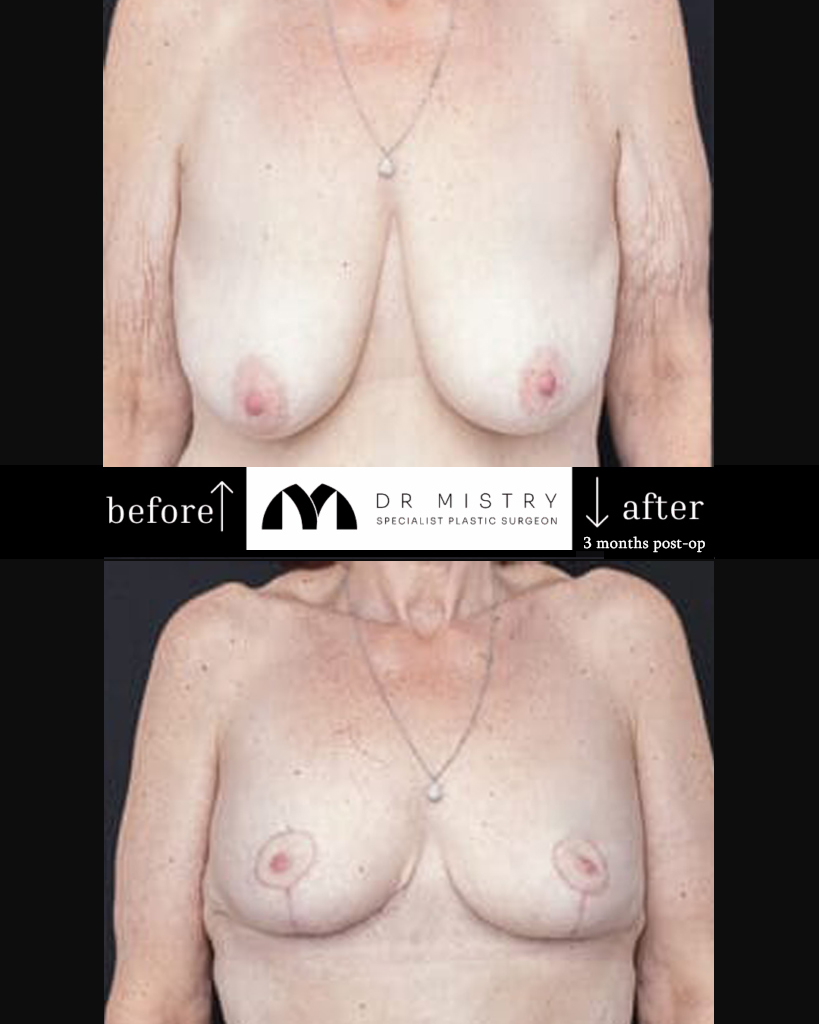
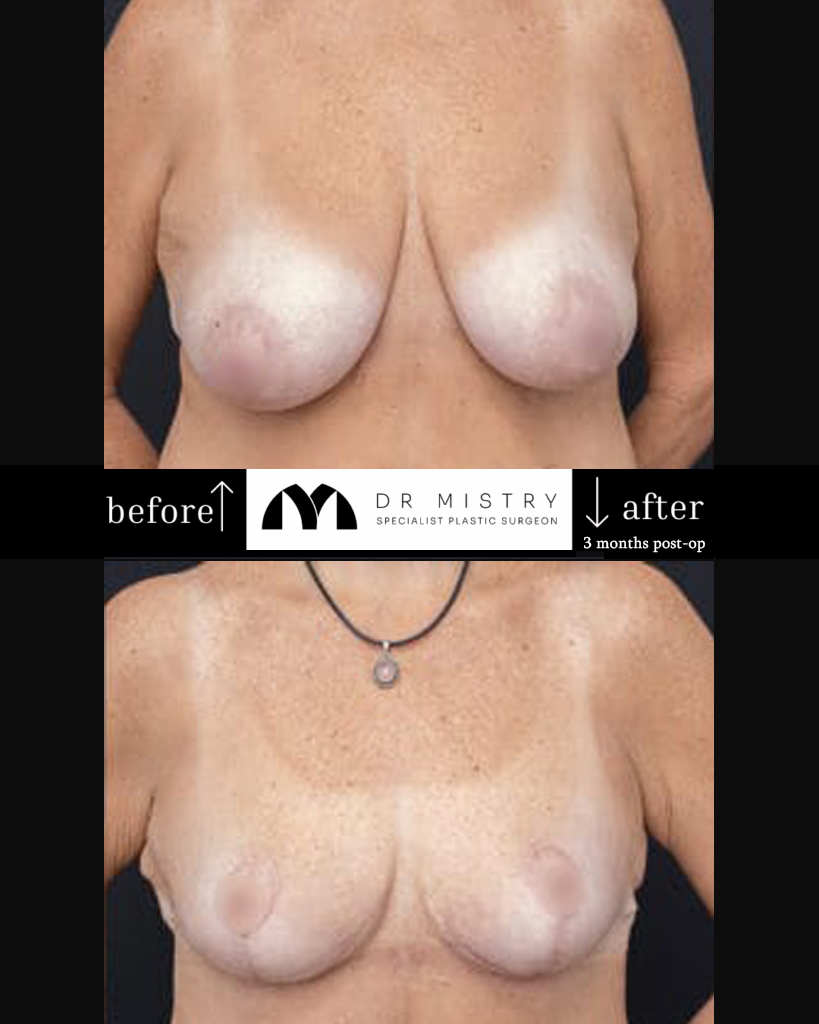
Breast Reduction Before & After Photos
How Long Can Swelling Last After Breast Reduction?
Swelling after breast reduction is expected and often changes gradually over weeks to months. It may fluctuate during the day and can be more noticeable after activity or prolonged standing.
Early swelling is usually more noticeable in the first few weeks.
One breast may appear more swollen or settle differently from the other.
Firmness can occur while the tissues are healing.
Wearing your support bra as directed may help with comfort.
Sudden, painful, increasing or one-sided swelling should be reviewed promptly.
Swelling is a normal part of healing, but any sudden or concerning change should be discussed with Dr Mistry’s team.
What Bruising, Firmness or Numbness Can Happen After Breast Reduction?
Bruising, firmness and altered sensation can occur after breast reduction surgery. These changes are often part of healing, but they should gradually improve rather than worsen.
Bruising is usually more noticeable during the early weeks.
Firmness can occur as swelling and tissue healing progress.
Nipple or breast sensation may feel reduced, heightened or uneven.
Sensation changes can take months to settle.
Increasing pain, redness, heat or swelling should be reviewed.
These symptoms can be expected during recovery, but any sudden or worsening change should be discussed with Dr Mistry’s team.
How Are Breast Reduction Scars Managed?
Breast reduction scars change over time and can continue maturing for 12 months or longer. Scar care should begin only when Dr Mistry confirms the incisions are ready.
Follow wound care instructions before using scar products.
Silicone gel or silicone sheets may be recommended once suitable.
Protect scars from sun exposure to reduce pigmentation changes.
Avoid bras or clothing that rub directly on healing incisions.
Scar massage should only begin if advised by Dr Mistry.
Scar care is a gradual process, and follow-up appointments help monitor how the incisions are healing.
When Can You Return to Work After Breast Reduction?
Return to work depends on your recovery, comfort and the type of duties you perform. Desk-based work may be possible earlier than work involving lifting, reaching or prolonged physical activity.
Office duties may be easier to resume than manual work.
Fatigue can continue even when discomfort has improved.
Jobs involving lifting, pushing or overhead movement need more caution.
Medical certificates and work restrictions can be discussed during follow-up.
Returning too early may increase swelling or discomfort.
Your return-to-work plan should be based on healing progress and Dr Mistry’s advice, not a fixed date.
When Is It Suitable to Drive After Breast Reduction?
Driving should wait until you can move comfortably, react safely and are no longer taking sedating pain medication. You also need to feel confident using the seatbelt and checking blind spots.
You should be able to steer and brake suddenly without hesitation.
Pain medicine must not affect alertness or reaction time.
Seatbelt pressure should not cause significant discomfort.
You need enough arm movement to drive safely.
Dr Mistry can advise when driving is appropriate for your recovery.
Driving too early can place you and others at risk, so it’s important to wait until you’re medically and physically ready.
When Can Exercise Resume After Breast Reduction?
Exercise should return gradually after breast reduction, with walking usually introduced before more demanding activity. Upper-body exercise, running and high-impact movement need more time and surgical clearance.
Short walks may be encouraged early to support circulation.
Avoid running, jumping and high-impact activity until cleared.
Upper-body resistance training should restart only when advised.
Swimming should wait until wounds are fully healed.
Stop activity if swelling, pulling or pain increases.
A staged return to exercise helps protect healing breast tissue and reduces unnecessary strain.
When Can You Lift Children or Carry Heavy Items?
Lifting children, groceries, laundry baskets or heavy bags should be avoided during the early recovery period. These activities can strain healing tissues and may increase swelling or discomfort.
Arrange help with childcare before surgery.
Use seated cuddles instead of lifting young children.
Avoid overhead reaching and carrying heavy loads.
Ask for support with shopping, cleaning and laundry.
Resume lifting only when Dr Mistry confirms it’s appropriate.
Planning help in advance can make this restriction easier to manage during early recovery.
What Should You Eat While Recovering?
Good nutrition can support wound healing, energy levels and bowel function after breast reduction. A balanced diet with adequate protein, fluids and fibre is useful while your activity level is reduced.
Include protein-rich foods such as eggs, fish, lean meats, legumes or dairy.
Drink enough water unless you’ve been advised otherwise.
Choose fibre-containing foods to help reduce constipation.
Limit alcohol while taking pain medicine or antibiotics.
Follow any dietary advice from Dr Mistry, your GP or dietitian.
Nutrition is only one part of recovery, but it can help support your body while it heals.
What Can Affect Breast Reduction Recovery?
Breast reduction recovery can be influenced by your overall health, surgical details and how closely you follow postoperative instructions. Factors such as smoking, medical conditions and activity levels can affect healing.
Smoking or vaping can interfere with wound healing.
Diabetes, some medicines and certain health conditions may affect recovery.
Larger reductions or more complex surgery may involve a longer recovery.
Too much activity too soon can increase swelling or discomfort.
Follow-up appointments help monitor healing and guide activity progression.
Understanding these factors helps set realistic expectations and supports safer recovery planning.
What Symptoms Need Medical Review?
Some swelling, bruising and tenderness are expected after breast reduction, but certain symptoms should be assessed promptly. Contact Dr Mistry’s team or seek urgent medical care if symptoms are sudden, severe or worsening.
Fever, chills or feeling increasingly unwell.
Increasing redness, warmth, swelling or discharge around the incision.
Heavy bleeding or wound separation.
Sudden chest pain, shortness of breath or dizziness.
Calf pain or one-sided leg swelling.
It’s better to ask for advice early than to wait with symptoms that may need review.
Why Choose Recovery Care With Dr Yezdi Mistry in Charlestown?
Dr Yezdi Mistry, Specialist Plastic and Reconstructive Surgeon in Charlestown, NSW, provides personalised postoperative care after breast reduction surgery. Follow-up appointments are used to assess healing, swelling, scars, comfort and return to activity.
Recovery instructions are tailored to your surgery.
Wounds, dressings and scars can be checked during review.
Bra fit, swelling and activity restrictions can be discussed.
Concerns can be assessed early before they progress.
Return to work, driving and exercise can be guided safely.
For advice specific to your recovery, contact Dr Yezdi Mistry’s Charlestown clinic to arrange a consultation or postoperative review.
Make an Enquiry Today
FAQs About Breast Reduction Recovery
Why do my breasts feel firm after breast reduction?
Firmness can occur as swelling and internal tissue healing progress. It usually softens gradually, but increasing firmness with pain, heat or redness should be reviewed.
Why does one breast look more swollen than the other?
Swelling may settle at different rates on each side. Sudden, painful or worsening one-sided swelling should be discussed with Dr Mistry’s team.
Why do I feel tired weeks after breast reduction surgery?
Fatigue can continue because your body is still healing, even when discomfort has improved. Rest, nutrition, hydration and gradual activity are important during this stage.
Can my bra affect breast reduction healing?
A poorly fitting bra can cause rubbing, pressure or irritation around healing incisions. Wear the support bra recommended by Dr Mistry and raise any fit concerns during follow-up.
Why does nipple sensation feel different after breast reduction?
Nipple or breast sensation may feel reduced, heightened or uneven after surgery. Sensation changes can take months to settle and should be monitored at review appointments.
Can constipation affect breast reduction recovery?
Constipation can increase discomfort and make movement harder during early recovery. Hydration, fibre, walking as advised and medication guidance from your care team may help.
Why are follow-up appointments needed if I feel well?
Follow-up appointments allow Dr Yezdi Mistry to assess wounds, swelling, scars, bra support and activity progression. Some concerns are easier to manage when identified early.
Schedule Your Breast Reduction Recovery Consultation with Dr Mistry
Breast reduction recovery takes planning, patience and realistic expectations. While early healing often occurs over several weeks, swelling reduction, scar maturation and breast settling can continue for months.
Recovery varies between patients.
Surgical instructions should be followed carefully.
Activity should increase gradually.
Support bras should be worn as directed.
Any concerning symptoms should be reviewed promptly.
To discuss breast reduction recovery and what may apply to your circumstances, contact Dr Yezdi Mistry, Specialist Plastic and Reconstructive Surgeon in Charlestown, NSW, to arrange a consultation.
Fill in your details and our friendly team will be in touch with you
Please Note: Information provided on Dr Mistry’s website is provided as a basic guide, it does not constitute a diagnosis and should not be taken as medical advice. Any surgical or invasive procedure carries risks.
A Newcastle Surgeon That Cares
“I care because it’s my job as a surgeon, as a plastic surgeon, to do the appropriate thing and to give you a good outcome. I want to leave knowing that I can tell a patient, hand on heart, that I did the very best I could and that I looked after them, so when I see them post op later that day or the next morning, that they feel they were in good hands.”