High Definition Liposuction has become an area of increasing interest among individuals who wish to understand the different approaches available for modifying areas of the body that do not easily change despite regular physical activity and stable weight. Liposuction has been used in surgical practice for several decades, and both the techniques and technologies supporting it have continued to advance. For people considering this type of surgery in Charlestown, Newcastle or the wider Hunter region, recognising the differences between High Definition Liposuction and other commonly used methods supports informed and realistic decision making.
Dr Yezdi Mistry, a Specialist Plastic and Reconstructive Surgeon practising in Charlestown, aims to provide clear, evidence informed explanations that align with professional standards and regulatory expectations. This article outlines how High Definition Liposuction compares with traditional suction assisted liposuction, power assisted methods, ultrasound assisted devices and laser assisted approaches. It also describes what individuals may expect during assessment, planning and the postoperative period. The information is designed to help patients understand their options without promising outcomes or suggesting that any person has an issue that requires fixing.
Understanding Liposuction in a Broad Sense
Liposuction is a surgical technique used to remove fat from selected areas through small incisions. The tissues are first prepared with a tumescent solution, which assists with fat removal, reduces bleeding and helps the surgeon navigate the area during the procedure. A narrow cannula attached to suction is then used to remove fat. Liposuction is intended for people who maintain stable weight and have regions that have not changed despite consistent lifestyle measures. It is not intended for weight reduction or the management of medical conditions.
All liposuction methods share the same underlying purpose, although they differ in how the fat is loosened before removal. Some rely entirely on manual movements, while others use mechanical vibration, ultrasound or laser energy to assist the process. These differences influence the surgeon’s ability to work at various tissue depths and the type of modification that can be achieved.
In Australia, any liposuction procedure must be performed in an accredited facility with appropriate monitoring and perioperative support. Dr Mistry follows these requirements closely and conducts a full assessment before determining suitability for surgery.
Traditional Suction Assisted Liposuction
Traditional suction assisted liposuction is one of the most established techniques in body modification surgery. It is used to adjust fat in areas such as the abdomen, thighs, arms, hips and under the chin. During this method, the surgeon manually moves a cannula through the tissue to loosen fat, which is then removed with suction.
This approach remains widely used because it allows significant control over depth, movement and direction. Surgeons with extensive experience in this method develop a detailed understanding of how different body regions respond and how to maintain overall balance across treated areas.
Working in deeper layers is generally predictable with this approach, though work near the surface requires careful technique because the superficial layer directly influences how the area appears after healing. This is one reason why energy assisted devices have been introduced to support more controlled removal in certain areas.
Power Assisted Liposuction
Power assisted liposuction uses a vibrating cannula to help loosen fat with less manual effort. The vibration supports consistent movement and can be useful in areas where fat is more fibrous or when larger areas are being treated.
Although the device modifies how the cannula behaves, the core principles of liposuction remain the same. The surgeon continues to direct the process and evaluate tissue response in real time. Power assisted liposuction can be used alone or combined with other techniques depending on the individual’s anatomy and goals.
This method is often suited to broader modification rather than highly detailed reshaping, although the final decision depends on Dr Mistry’s assessment and the patient’s expectations.
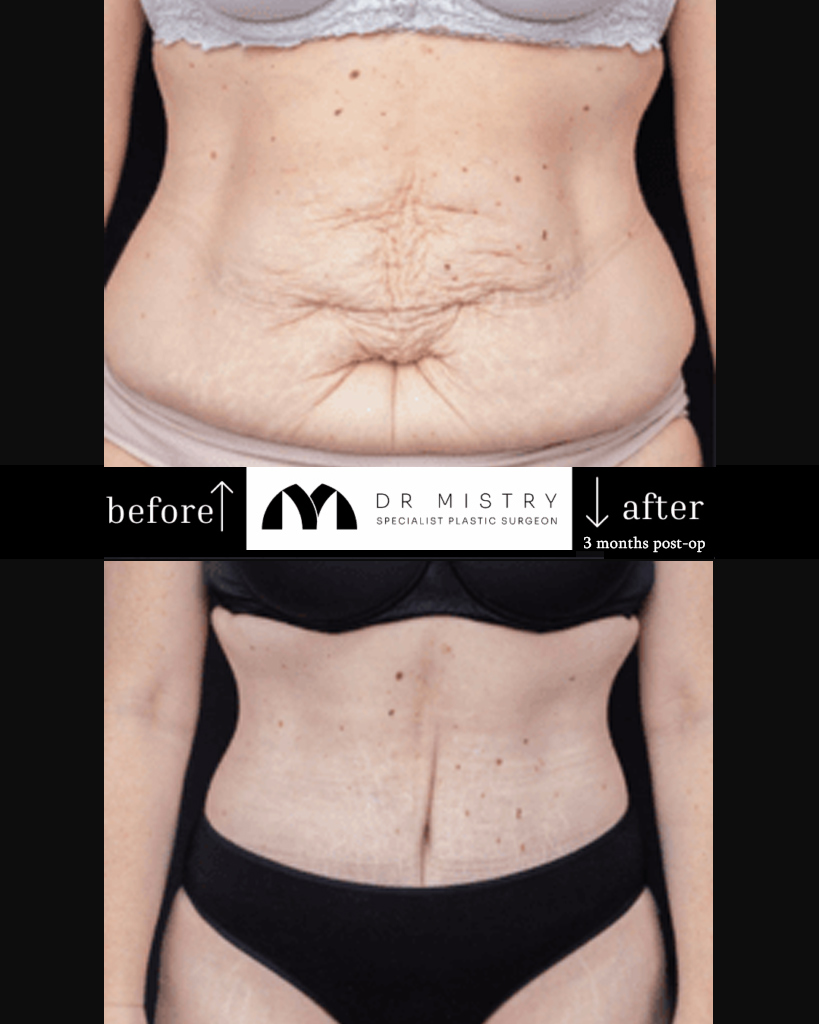
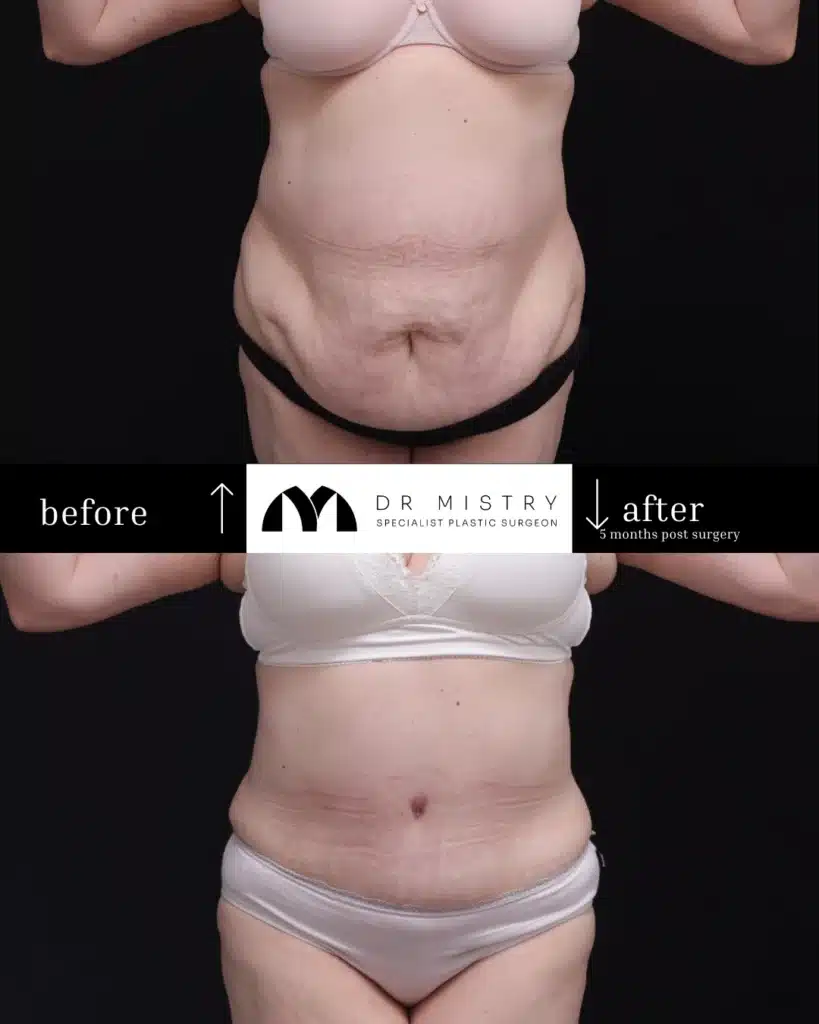
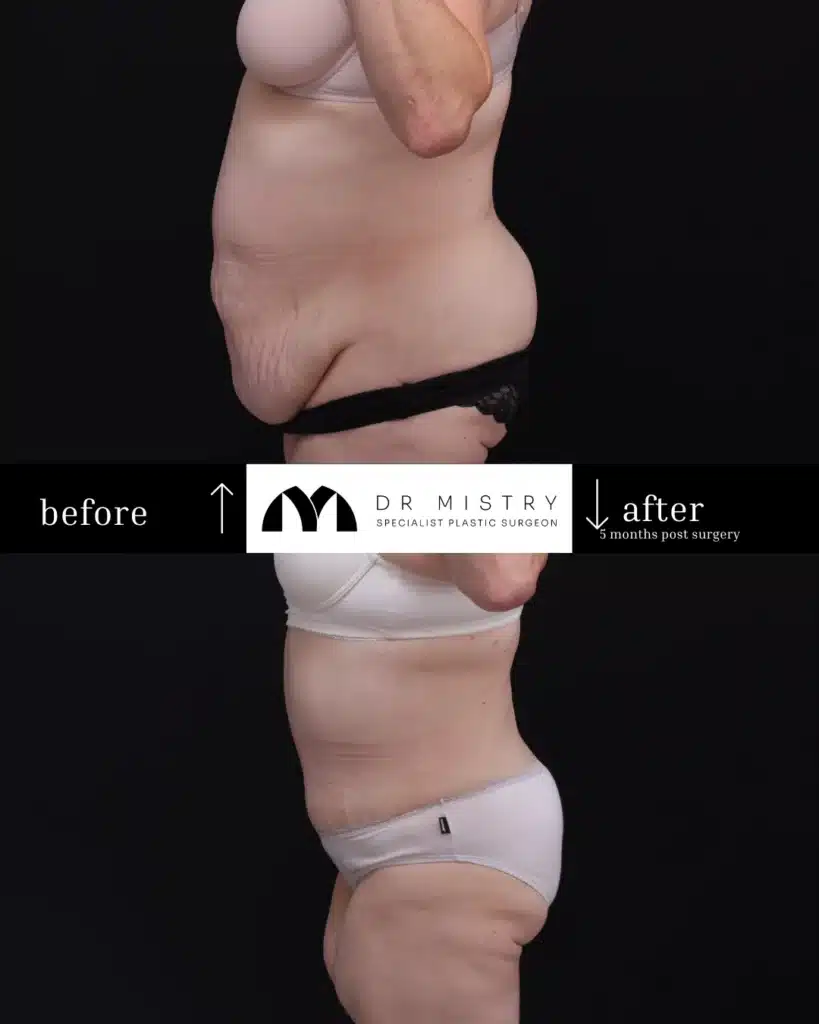
Liposuction Before and After Photos
Ultrasound Assisted Liposuction Including VASER
Ultrasound assisted liposuction uses ultrasonic energy to assist with loosening fat before removal. VASER is one of the widely used third generation ultrasound assisted systems in Australia. These systems allow controlled energy delivery, supporting precise work in both deep and superficial layers.
This approach is commonly associated with High Definition Liposuction because it can support more detailed work in the superficial fat layer. The ability to modify these layers safely may help highlight natural anatomical transitions in suitable individuals.
Studies have documented differences between ultrasound assisted and traditional liposuction, such as reduced blood content in the aspirate and, in some cases, greater skin contraction relative to the amount of fat removed. However, changes in discomfort, swelling or recovery time may vary among individuals, and device choice alone does not determine outcome.
As with all energy based devices, ultrasound assisted liposuction requires careful control of settings. Dr Mistry uses these technologies selectively based on the individual’s presentation and the surgical plan.
Laser Assisted Liposuction
Laser assisted liposuction uses targeted laser energy to heat and loosen fat, which is then removed through suction. Some systems aim to support collagen production by heating deeper tissues, although the extent of this depends on individual skin characteristics and the device used.
Laser assisted liposuction may be suitable for individuals seeking moderate modification in certain regions, but it is less commonly used for the level of surface detail associated with High Definition Liposuction. Its effectiveness depends on tissue type, device selection and clearly defined goals.
Correct technique is essential because energy based devices can increase the risk of complications if not used appropriately.
What Defines High Definition Liposuction
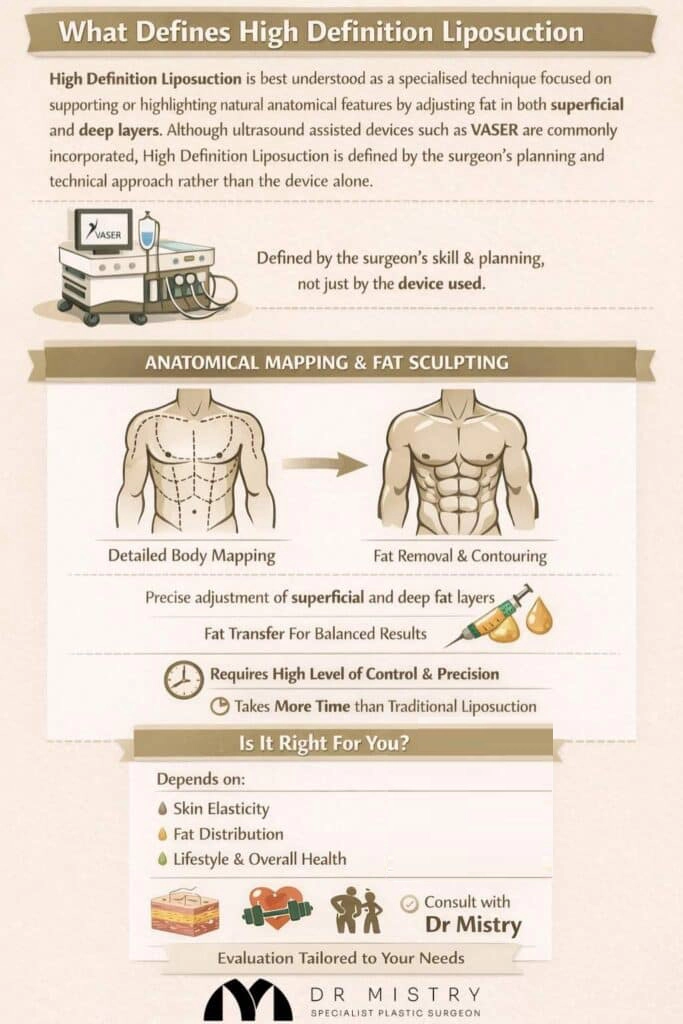
High Definition Liposuction is best understood as a specialised technique focused on supporting or highlighting natural anatomical features by adjusting fat in both superficial and deep layers. Although ultrasound assisted devices such as VASER are commonly incorporated, High Definition Liposuction is defined by the surgeon’s planning and technical approach rather than the device alone.
The method begins with detailed mapping of anatomical structures, natural lines and planned areas of adjustment. The surgeon then removes or preserves fat in specific patterns that align with the underlying anatomy. In some cases, small amounts of fat may be transferred to promote balanced transitions.
Because High Definition Liposuction involves modification of the superficial layer, it requires a high level of control. Even subtle variations in depth or technique can influence how the area appears following recovery. The procedure often requires more time than traditional liposuction due to this level of detail.
Not every individual is suited to High Definition Liposuction. Suitability depends on factors such as skin elasticity, fat distribution, lifestyle, goals and overall health. During consultations at his Charlestown practice, Dr Mistry evaluates these elements carefully.
Technical Differences Between High Definition and Other Liposuction Techniques
The differences between High Definition Liposuction and other approaches relate primarily to intention and detail. Traditional liposuction focuses on general reshaping, while High Definition Liposuction focuses on supporting visible anatomical transitions.
The technique requires precise work in superficial layers, which directly influence the appearance of the area once healing occurs. Technologies that support controlled modification in this layer, such as ultrasound assisted devices, are commonly used with this method.
High Definition Liposuction also includes structured postoperative care. Compression garments may be used for specific periods to guide tissue behaviour. Additional supportive therapies may be discussed based on individual needs. These steps are tailored carefully to each patient.
Safety Considerations Across All Liposuction Techniques
Liposuction carries potential risks regardless of the technique used. Temporary effects may include swelling, bruising, changes in sensation and areas of firmness during early healing. More significant risks include infection, haematoma, seroma or unevenness in how tissues settle. Rare but important risks include thromboembolic events, anaesthetic complications or injury to deeper structures.
Dr Mistry ensures that every patient has the opportunity to discuss these risks thoroughly. All procedures are performed in accredited facilities with appropriate monitoring and perioperative support. Recovery is reviewed at scheduled intervals so that guidance can be provided throughout the healing period.
The Role of Renuvion in Selected Cases
Renuvion is a device that uses helium plasma and radiofrequency energy to heat subcutaneous tissues in a controlled manner. It is approved for specific uses and may be incorporated into a surgical plan to support tissue firmness in selected situations.
Its suitability depends on an individual’s skin behaviour, treatment goals and Dr Mistry’s clinical assessment. It is not intended to replace procedures that remove excess tissue when more substantial adjustment is required.
High Definition Liposuction FAQs
Can High Definition Liposuction be combined with traditional liposuction in one procedure?
Yes, in selected cases Dr Mistry may combine High Definition Liposuction with traditional methods to support balanced changes across different regions. The decision depends on tissue behaviour, overall goals and what is considered medically appropriate for the individual.
Does High Definition Liposuction change how muscle definition is created on the body?
High Definition Liposuction does not change the muscles themselves but instead adjusts fat layers around them to support the appearance of natural transitions. The visibility of these transitions depends on anatomy, skin behaviour and lifestyle factors.
Is High Definition Liposuction suitable for individuals who fluctuate in weight?
Weight fluctuations can influence how the tissues respond and how long certain changes may remain consistent. Dr Mistry generally advises that individuals maintain a stable weight before considering any liposuction method.
Can High Definition Liposuction be performed on smaller areas such as the arms or above the knees?
High Definition techniques can be applied to smaller regions when the anatomical features and tissue quality allow for this level of detail. Suitability is assessed during consultation, as not all areas respond the same way to superficial adjustments.
Does High Definition Liposuction require longer use of compression garments than other methods?
High Definition Liposuction often involves a structured compression plan because superficial tissue layers are adjusted more precisely. The duration varies by individual and is discussed during postoperative visits with Dr Mistry.
Is there a difference in how swelling behaves after High Definition Liposuction?
Some individuals may experience longer periods of swelling due to the detailed work performed in superficial layers. This is monitored closely during follow up appointments so that guidance can be tailored to each person’s healing pattern.
Can someone return to resistance training after High Definition Liposuction?
Return to physical activity, including resistance training, depends on the extent of surgery and the individual’s healing progression. Dr Mistry provides a personalised timeline based on tissue response and postoperative assessment.
Are results from High Definition Liposuction affected by posture or core strength?
Posture and core engagement can influence how natural anatomical lines appear in everyday movement. While the surgery adjusts fat layers, maintaining general conditioning may support how these features present over time.
Is High Definition Liposuction appropriate for individuals with minimal visible muscle structure?
High Definition Liposuction relies partly on the presence of natural anatomical lines beneath the fat layer. Individuals without these underlying structures may still benefit from other forms of liposuction, but suitability is determined during assessment.
Do individuals feel different sensations during recovery from High Definition Liposuction compared with other techniques?
Some people notice variations in firmness, sensitivity or tissue behaviour because superficial layers are addressed more extensively. These sensations are usually temporary and are reviewed during postoperative checks to ensure healing is progressing as expected.
Medical References
- Tambasco, D., Hoyos, A., Perez, M., Tomaselli, F., Mir, J., & Albanese, R. (2024). Optimizing safety and precision for secondary liposuctions integrating intraoperative ultrasound with VASER technology. Aesthetic Surgery Journal. – https://doi.org/10.1093/asj/sjae213
- Escandón, J. M., Vyas, K. S., & Manrique, O. J. (2022). High-Definition Lipoplasty in Male Patients: A Systematic Review of Surgical Techniques and Outcomes. Aesthetic Surgery Journal, 42(1), 68–85. – https://doi.org/10.1093/asj/sjab300
- Nayak, S. (2025). Body contouring using VASER liposuction: Retrospective analysis of 175 consecutive cases at a single centre. International Journal of Aesthetic Plastic Surgery, 1(1), 63–69. – https://journals.sagepub.com/doi/10.1177/30499240251322302
Are you Ready for Plastic Surgery? Take Our Quiz
High Definition Liposuction for Patients
Individuals who explore High Definition Liposuction often have specific goals relating to how they would like certain areas to appear. Some may prefer general reshaping, while others are interested in more defined transitions that align with their natural anatomy.
Consultations at Dr Mistry’s Charlestown clinic focus on medical history, lifestyle factors, physical examination and goal setting. This process supports the development of a plan that is medically appropriate and aligned with the individual’s expectations.
How to Decide Which Technique Is Appropriate
Selecting the most appropriate liposuction technique depends on multiple factors, including tissue thickness, skin elasticity, fat distribution, lifestyle and long term goals. Some individuals may benefit from a combination of approaches.
During consultations, Dr Mistry explains how each method works, what changes may be possible and what recovery typically involves. This helps individuals understand the rationale behind specific recommendations.
Considerations for Patients
High Definition Liposuction and other liposuction techniques share a common foundation but differ in depth, detail and intended outcome. High Definition Liposuction involves targeted modification of both deep and superficial fat layers to support the visibility of anatomical features. Traditional and power assisted methods may be more appropriate for general reshaping, while ultrasound assisted devices such as VASER are often incorporated into High Definition Liposuction to support controlled work in the superficial layer.
For individuals in Charlestown, Newcastle and surrounding areas, seeking a consultation with a qualified practitioner is the most important step. Dr Mistry’s assessment process focuses on clinical experience, training, evidence informed guidance and the individual’s long term wellbeing. This supports the development of a plan that aligns with personal goals while maintaining realistic expectations and appropriate safety considerations.
Download Dr Mistry’s Cost of Surgery Guide


Further Reading
- Read more about Vaser Liposuction
- Read more about Power-Assisted Liposuction (PAL) with MicroAire
- Read more about Body Lift (Upper & Lower)
- Read more about Back Liposuction Procedure Page
- Read more about Chest Liposuction Procedure Page
- Read Dr Mistry’s Blog on What is High Def Lipo and How Does it Work?
- Read Dr Mistry’s Blog on Renuvion: Advanced Technology for Precision in Body Contouring
- Read Dr Mistry’s Blog on What to Know About High Definition Liposuction with Dr Yezdi Mistry
- Read Dr Mistry’s Blog on Is Abdominoplasty Right for You? Exploring Candidacy Considerations