Women seeking a reduction in breast size or weight often encounter two different surgical options during their research: breast reduction surgery and breast liposuction. While both procedures aim to reduce breast volume, they address very different anatomical components and are suited to different patient profiles.
Understanding the distinction between these approaches is essential for making an informed decision. At his practice in Charlestown, Newcastle NSW, Dr Yezdi Mistry, Specialist Plastic and Reconstructive Surgeon, provides detailed assessments to help patients understand which option aligns best with their anatomy, symptoms, and long-term expectations.
Understanding Breast Composition
The female breast is made up of glandular tissue, fatty tissue, connective structures, skin, and an underlying muscular foundation. The proportion of glandular to fatty tissue differs between individuals and can change over time due to hormonal influences, pregnancy, breastfeeding, weight changes, and ageing. This variation plays a central role in determining which surgical approach may be effective.
Breasts with a higher proportion of glandular tissue tend to feel firmer and heavier. These breasts are less responsive to fat-only removal techniques because the bulk of the volume is not composed of fat. In contrast, breasts with a higher fatty component are often softer and may change noticeably with weight fluctuation.
Skin quality is another critical factor. Skin elasticity influences how the breast adapts after volume reduction and whether reshaping or lifting is required. During consultation, Dr Mistry evaluates tissue density, skin behaviour, and breast position to determine whether breast reduction surgery or breast liposuction is likely to provide a predictable and balanced outcome.
What Is Breast Reduction Surgery?
Breast reduction surgery, also known as reduction mammaplasty, involves the removal of excess glandular tissue, fat, and skin. The procedure also reshapes the remaining breast tissue and repositions the nipple-areola complex to a more proportionate location on the chest.
This approach addresses both breast size and structure. The surgery is commonly considered by women who experience physical symptoms such as neck, shoulder, or back discomfort, bra strap indentation, or difficulty with physical activity. These symptoms often result from the combined effects of breast weight, position, and strain on the upper body. Breast reduction aims to reduce this mechanical load while improving proportional balance.
Because breast reduction addresses multiple anatomical layers, it allows for comprehensive correction. Dr Mistry’s surgical planning focuses on proportion, symmetry, circulation, and long-term tissue behaviour. Each procedure is customised to the individual rather than following a standardised volume target.
What Is Breast Liposuction?
Breast liposuction reduces breast size by removing fatty tissue only, using fine cannulas and controlled suction. It does not remove glandular tissue, does not excise excess skin, and does not reposition the nipple or reshape the breast structure. As a result, its application is limited to a smaller subset of patients.
This approach may be suitable for women whose breasts are predominantly fatty, with good skin elasticity and minimal droop. In these cases, the skin may adapt naturally after fat removal, allowing the breast to settle without surgical lifting. Even then, the degree of reduction achievable is usually modest.
Breast liposuction is not appropriate for women with dense glandular breasts, significant skin laxity, or symptoms related to breast position. Dr Mistry carefully assesses these factors during consultation and explains the limitations of liposuction when anatomy is not suitable. This ensures that expectations remain realistic and medically grounded.
Key Differences Between Breast Reduction and Breast Liposuction
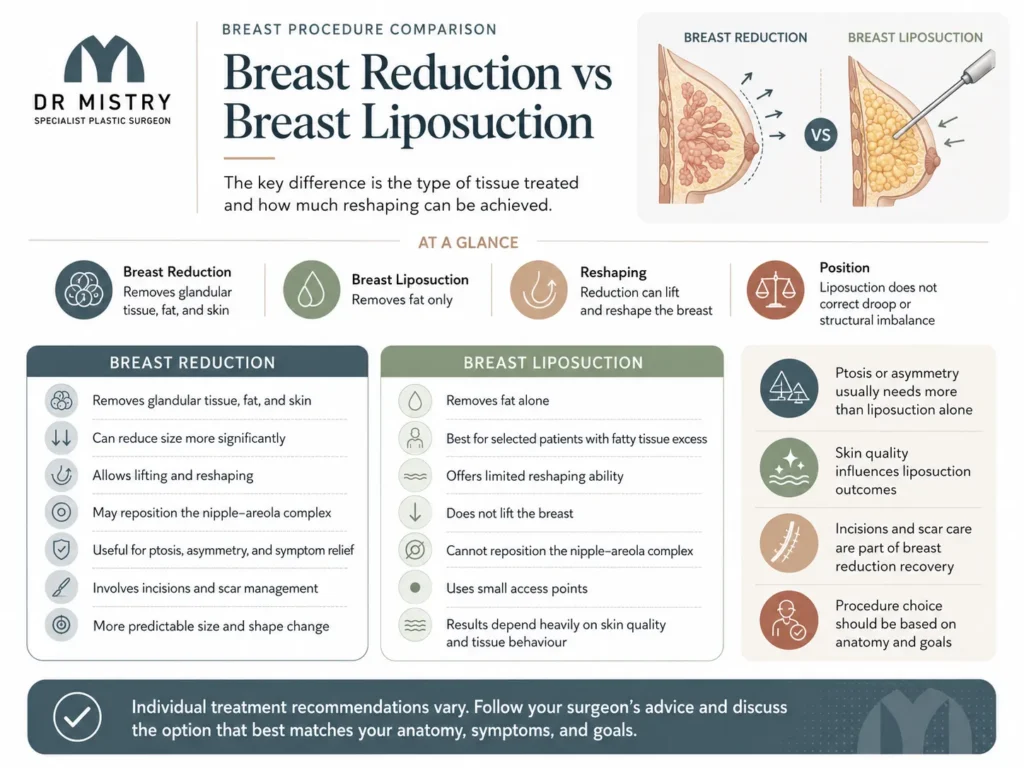
The most important distinction between the two procedures is the type of tissue addressed. Breast reduction removes glandular tissue, fat, and skin, while breast liposuction removes fat alone. This difference has a direct impact on how much size reduction and reshaping can be achieved.
Breast reduction surgery allows for lifting and reshaping of the breast, including repositioning of the nipple–areola complex. Liposuction does not alter breast position and cannot correct droop or structural imbalance. For patients with breast ptosis or asymmetry, liposuction alone is unlikely to provide meaningful improvement.
Recovery after breast reduction and outcomes also differ. Breast reduction involves incisions and scar management but provides more predictable changes in size, shape, and symptom relief. Liposuction involves smaller access points but relies heavily on skin quality and tissue behaviour, which can make results less consistent in some patients.
Which Patients May Be Suitable for Breast Liposuction?
Breast liposuction may be considered for women with soft, fatty breasts and minimal glandular density. These patients often notice that their breast size fluctuates with weight changes, suggesting a higher proportion of fat. Good skin elasticity is essential for the breast to adapt after fat removal.
Patients seeking only a small reduction in volume without the need for reshaping may also be candidates. However, even in suitable cases, results tend to be subtle and may not address symptoms related to breast weight or position. Liposuction does not correct droop or nipple placement.
Dr Mistry emphasises that breast liposuction is not a substitute for breast reduction surgery. It is a specific technique appropriate only when anatomy supports its use and when patients understand its limitations. Careful selection is essential to avoid disappointment and ensure safe outcomes.
Which Patients Benefit More From Breast Reduction Surgery?
Breast reduction surgery is typically more appropriate for women with dense glandular tissue, significant breast weight, or noticeable droop. It is also preferred when physical symptoms such as back, shoulder, or neck discomfort are present. These symptoms often relate to the combined effect of breast size and position rather than fat volume alone.
Women who have experienced long-standing discomfort or functional limitation often benefit from the structural changes achieved through breast reduction. By removing tissue and reshaping the breast, the procedure addresses both mechanical strain and proportional imbalance. This can result in improved posture and greater ease with daily activities.
At his Charlestown practice, Dr Mistry explains how each patient’s anatomy influences surgical planning. This ensures that the recommended approach aligns with both symptom relief and long-term tissue behaviour, rather than focusing solely on size reduction.
Breast Reduction Before and After Photos
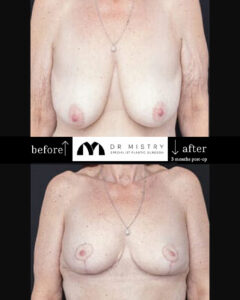
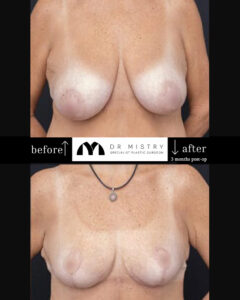

Disclaimer: The outcomes shown are specific to those patients and may not reflect the results experienced by others, as individual outcomes can vary due to a range of factors.
Healing and Long-Term Considerations
Recovery differs between the two procedures due to their scope. Breast reduction involves a structured healing process, with swelling and firmness gradually settling over several months. Scars mature over time, and postoperative care focuses on comfort, mobility, and tissue support.
Breast liposuction typically involves less surface disruption but still requires monitoring as swelling resolves. Compression garments may be recommended, and final results depend on how the skin adapts to volume reduction. In some cases, uneven settling may become apparent as healing progresses.
Regardless of the approach, breasts continue to change with age, weight variation, and hormonal influences. Dr Mistry discusses these long-term considerations during consultation to ensure patients have realistic expectations about durability and future changes.
The Importance of Specialist Assessment Before Undergoing These Procedures
Choosing between breast reduction and breast liposuction requires detailed anatomical assessment and surgical expertise. In Australia, this evaluation should be performed by a Specialist Plastic Surgeon with accredited training in breast surgery. Proper assessment reduces the risk of inappropriate procedure selection.
Dr Yezdi Mistry holds FRACS (Plastic Surgery) and is a Fellow of the Royal Australasian College of Surgeons, reflecting completion of extensive specialist training. His experience across reconstructive and aesthetic breast procedures supports careful decision-making and patient safety.
Patients are encouraged to verify surgeon credentials through the RACS or Australian Society of Plastic Surgeons (ASPS). This ensures that care is delivered within recognised medical, ethical, and regulatory frameworks.
Breast Reduction Vs Breast Liposuction FAQs
Why can two women with the same bra size be offered completely different procedures?
Bra size does not accurately reflect breast tissue composition. One woman may have predominantly fatty tissue, while another has denser glandular tissue or skin laxity. Surgical recommendations are based on anatomy rather than cup size alone.
Can breast liposuction reduce breast heaviness if my breasts feel firm rather than soft?
Firm breasts usually contain a higher proportion of glandular tissue. Because liposuction only removes fat, it is unlikely to significantly reduce weight or discomfort in this situation. Breast reduction surgery is typically more effective for firm, dense breasts.
Why does breast liposuction not change nipple position?
Liposuction works beneath the skin to remove fat but does not address skin excess or breast structure. Nipple position is determined by skin and connective tissue, which are reshaped only during breast reduction surgery. As a result, lifting cannot be achieved with liposuction alone.
Is it possible to start with liposuction and later need breast reduction?
Yes, this can occur if liposuction does not provide sufficient size reduction or if skin does not adapt as expected. This is why careful assessment is important before choosing liposuction alone. Dr Mistry discusses this possibility during consultation to support informed decision-making.
Which procedure is more reliable for relieving neck, shoulder, or back discomfort?
Breast reduction surgery is generally more reliable because it removes glandular tissue and rebalances breast weight and position. Liposuction may reduce volume in select cases but does not address structural factors that contribute to physical strain.
Why does skin elasticity matter so much for breast liposuction outcomes?
After fat removal, the skin must contract and adapt to the new volume. If elasticity is reduced, the breast may appear loose or uneven. Breast reduction surgery directly addresses excess skin, making outcomes more predictable when elasticity is limited.
Can breast liposuction correct breast asymmetry?
Only in very specific cases where asymmetry is due purely to fat distribution. If differences involve glandular tissue, nipple position, or breast shape, breast reduction or combined techniques are usually required. Precise assessment determines what is achievable.
Does breast reduction always involve larger scars than liposuction?
Breast reduction does involve incisions to remove tissue and reshape the breast, whereas liposuction uses small access points. However, the trade-off is that breast reduction provides more predictable size, shape, and symptom improvement. Scar management is an important part of postoperative care.
Why might liposuction reduce size but not improve how clothing fits?
Clothing fit is influenced by breast shape, projection, and position, not just volume. Liposuction does not reshape the breast mound or lift the tissue. Breast reduction surgery addresses these factors more comprehensively.
How does a surgeon decide which option is medically appropriate?
The decision is based on breast tissue composition, skin quality, breast position, physical symptoms, and overall health. Dr Mistry conducts detailed measurements and clinical assessments to determine which procedure aligns best with anatomy and expectations. This ensures recommendations are evidence-based rather than trend-driven.
Medical References
- Breast Reduction Performed by Liposuction / Dermatologic Surgery / https://journals.lww.com/dermatologicsurgery/abstract/2006/09000/breast_reduction_performed_by_liposuction.3.aspx
- A systematic review of patient-reported outcome measures for women with macromastia who have undergone breast reduction surgery / Gland Surgery / https://pmc.ncbi.nlm.nih.gov/articles/PMC6722998/
- Breast Reduction (Reduction Mammoplasty) / Australian Society of Plastic Surgeons / https://plasticsurgery.org.au/procedures/surgical-procedures/breast-reduction/
- Breast Reduction Using Liposuction Alone / Seminars in Plastic Surgery / https://pmc.ncbi.nlm.nih.gov/articles/PMC2884718/
Are you Ready for Plastic Surgery? Take Our Quiz
Evidence-Based Practice
All information provided by Dr Yezdi Mistry is based on current peer-reviewed research and recognised surgical standards. Content aligns with the professional guidelines of the Royal Australasian College of Surgeons (RACS), the Australian Society of Plastic Surgeons (ASPS), and AHPRA, ensuring accurate, balanced, and patient-focused education.
A Patient-Centred Approach in Charlestown
Every woman’s breast anatomy and experience of discomfort is unique. Dr Mistry’s approach prioritises education, clear explanation, and individualised planning so patients understand their options fully. Consultations focus on anatomy, symptoms, and realistic outcomes rather than marketing language.
Serving patients in Charlestown, Newcastle and the Hunter region, Dr Mistry provides balanced guidance grounded in evidence-based practice. His goal is to support informed decision-making through transparency and clinical accuracy.
Whether considering breast reduction surgery or exploring alternatives such as liposuction, patients receive comprehensive information tailored to their individual presentation.
Taking the Next Step: Booking a Consultation With Dr Mistry
If you are considering a reduction in breast size and are unsure whether breast reduction surgery or breast liposuction is more suitable, a professional assessment can provide clarity. Understanding your breast composition and anatomy is essential before deciding on any procedure.
Dr Yezdi Mistry, Specialist Plastic and Reconstructive Surgeon in Charlestown, offers detailed consultations focused on education, safety, and realistic expectations. To arrange an appointment, contact his Charlestown practice and take the next step toward informed, medically appropriate care.
Download Dr Mistry’s Breast Surgery Guide


Further Reading
- Read more about Breast Lift (Mastopexy)
- Read more about Breast Implant Removal
- Read more about Breast Implant Replacement
- Read Dr Mistry’s Blog on The Possible Benefits of Breast Reduction: More Than Just Aesthetic
- Read Dr Mistry’s Blog on Breast Reduction FAQs
- Read Dr Mistry’s Blog on Breast Reduction Recovery Guide: What to Expect After Surgery in Newcastle